

The Missing Layer Between Electrical Protection and Fire Safety: Why Real-Time Electrical Anomaly Monitoring Matters
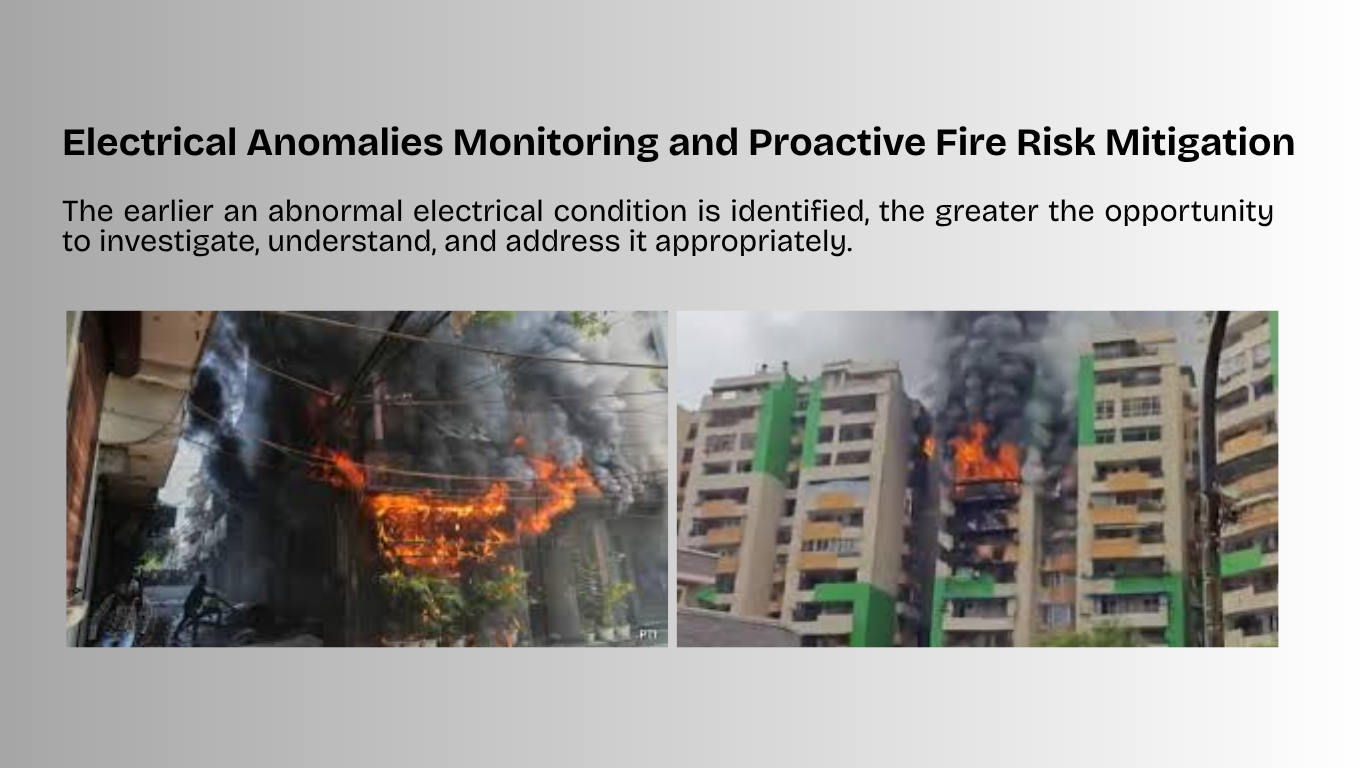
The recent fire at Lemon Green Restaurant in Delhi’s Hauz Rani, following the earlier fire incident at Gaur Green Avenue housing society in Indirapuram, Ghaziabad, has once again brought building safety into public discussion.
While the exact causes of individual incidents are determined through official investigations, such events remind us of a larger reality: modern buildings are complex ecosystems where safety depends on the health and performance of multiple interconnected systems.
When a fire occurs, attention naturally turns toward emergency response.
- Were there fire extinguishers?
- Did smoke detectors function properly?
- Were evacuation procedures followed?
- How quickly did emergency services respond?
These are important questions. However, an equally important question often receives less attention:
Can abnormal conditions be identified before they evolve into emergencies?
For facility managers, maintenance engineers, housing society committees, restaurant operators, commercial building owners, and safety professionals, this question is becoming increasingly relevant.
As buildings become more dependent on electrical infrastructure, elevators, HVAC systems, water pumps, kitchen equipment, automation systems, DG sets, and digital technologies, understanding the health of the underlying electrical network becomes an essential part of risk management.
Fire Incidents Have Multiple Causes
It is important to acknowledge that fire incidents can originate from a variety of causes.
Cooking operations, combustible materials, equipment malfunctions, fuel systems, maintenance deficiencies, human error, and electrical faults can all contribute to fire incidents under different circumstances.
It would therefore be inappropriate to assume that any specific incident was caused by an electrical fault unless confirmed by investigation. At the same time, electrical systems deserve special attention because they are among the few infrastructures that operate continuously throughout a building.
Unlike many mechanical systems, electrical abnormalities often remain hidden.
- A leaking pipe can be seen.
- A vibrating machine can be felt.
- A worn bearing often produces noise.
Electrical systems behave differently. Problems can develop inside switchboards, cables, busbars, electrical panels, distribution systems, motors, transformers, HVAC equipment, refrigeration systems, and connected loads without producing obvious visual warning signs. This hidden nature of electrical infrastructure makes visibility especially important.
The Growing Electrical Complexity of Modern Buildings
A modern commercial or residential building is no longer a simple electrical installation. Consider a typical housing society. Its electrical network may support:
- Elevators
- Water pumps
- Sewage treatment plants
- Common-area lighting
- Access control systems
- Fire pumps
- DG sets
- HVAC equipment
- EV charging infrastructure
Similarly, restaurants and commercial establishments depend on:
- Refrigeration systems
- Kitchen equipment
- Ventilation systems
- Air conditioning systems
- Lighting networks
- Billing and communication systems
Each additional system increases the complexity of the electrical network. More importantly, these systems operate under constantly changing load conditions throughout the day.
- Morning startup loads differ from afternoon loads.
- Weekend usage patterns differ from weekday operations.
- Peak occupancy conditions differ from low-demand periods.
Electrical systems must continuously adapt to these changing conditions.
The Missing Layer Between Protection and Detection
Most facilities already have multiple layers of protection.
- Circuit breakers protect against excessive currents.
- Protective relays isolate abnormal electrical conditions.
- Smoke detectors identify smoke.
- Heat detectors identify elevated temperatures.
- Fire suppression systems respond after fire conditions develop.
These systems are indispensable. However, they are largely designed to respond after predefined thresholds have been crossed. The challenge is that electrical systems often begin exhibiting warning signs long before a protection device operates or a fire detection system activates. What frequently remains missing is continuous visibility into those developing conditions.
Why Traditional Maintenance Has Limitations
Most facilities operate using a combination of reactive and preventive maintenance.
In reactive maintenance, action is taken after a problem becomes visible.
- A breaker trips.
- Equipment stops functioning.
- Residents complain.
- Operations are disrupted.
Preventive maintenance improves reliability by introducing periodic inspections and scheduled servicing. However, electrical systems operate continuously while inspections occur periodically.
A developing abnormal condition may emerge the day after an inspection and remain unnoticed until the next maintenance cycle. For critical infrastructure, this creates a visibility gap. This is where continuous electrical monitoring begins to add value.
What Happens Before an Electrical Failure?
Many people imagine electrical failures as sudden events. In reality, many failures develop progressively. Before a failure becomes visible, the electrical system may exhibit measurable abnormalities.
- Repeated voltage fluctuations.
- Abnormal loading patterns.
- Recurring leakage conditions.
- Phase imbalances.
- Unusual consumption behaviour.
- Intermittent arcing.
These conditions may not immediately stop operations. In fact, the building may appear to function normally. Yet the electrical network may already be communicating that something requires attention.
The challenge is recognizing those signals before they become larger problems.
Electrical Anomalies and Real-time Monitoring
Modern electrical anomaly monitoring systems continuously observe the health of electrical infrastructure and identify operating conditions that may warrant investigation.
Some of the key anomalies include: Over Voltage, Under Voltage, Over Current, High Inrush, Unbalanced Loads, Phase Loss, Phase Reversal, High Harmonics, Power Factor Issues, Arcing, Short Circuit Events, Earth Leakage, Voltage Quality Issues, Over Consumption, Neutral Loss…
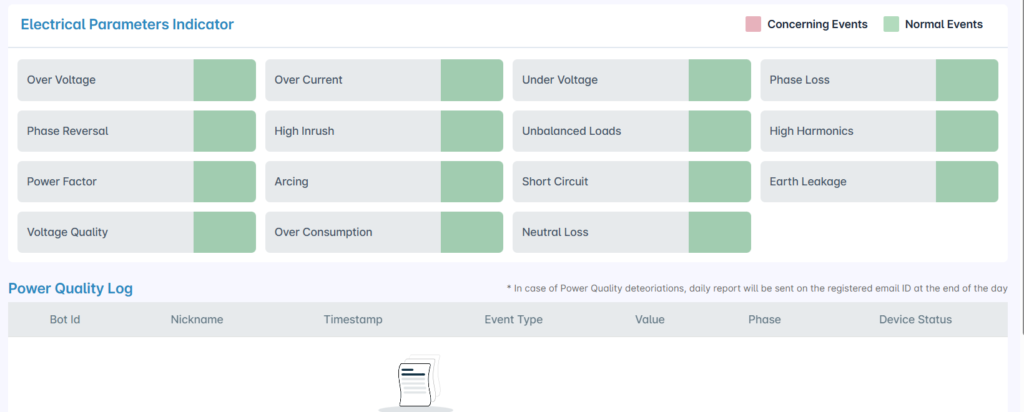
Individually, an anomaly does not necessarily indicate imminent failure. However, recurring anomalies, worsening trends, or multiple anomalies occurring together can provide valuable insight into the condition of the electrical system. The objective is not to predict every failure. The objective is to improve visibility.
A Closer Look at major Electrical Anomalies
| Electrical Condition / Anomaly | What It Indicates / Why It Matters |
| Over Voltage & Under Voltage | Electrical equipment is designed to operate within specific voltage limits. Persistent deviations may place stress on connected equipment and affect operational performance. |
| Over Current | Overcurrent conditions may indicate excessive loading, abnormal operation, or developing faults that deserve attention. |
| High Inrush Current | Large startup currents are common in many electrical systems. However, repeated or excessive inrush conditions may impact equipment performance and system stability. |
| Unbalanced Loads | When electrical loads are not evenly distributed across phases, efficiency and equipment performance can be affected. |
| Phase Loss & Phase Reversal | Three-phase equipment relies on correct phase availability and sequence. Abnormal phase conditions can significantly affect equipment operation. |
| High Harmonics | Harmonic distortion can increase thermal stress on transformers, conductors, and electrical equipment while reducing overall efficiency. |
| Poor Power Factor | Power factor issues may indicate inefficient utilization of electrical power and contribute to higher operating costs. |
| Arcing | Arcing represents abnormal electrical discharge activity. Even intermittent arcing events deserve investigation because they may indicate deteriorating electrical conditions. |
| Short Circuit Events | Short circuits represent severe fault conditions and require immediate attention. |
| Earth Leakage | Earth leakage indicates unintended current flow paths and may warrant investigation of insulation health, moisture ingress, equipment deterioration, or installation issues. |
| Voltage Quality Issues | Voltage disturbances can affect equipment reliability and overall operational stability. |
| Over Consumption | Unexpected increases in energy consumption may indicate inefficiencies, abnormal loading, or operational changes that deserve evaluation. |
| Neutral Loss | Neutral loss can create significant voltage imbalance across connected loads and may affect sensitive equipment throughout the facility. |
What Would a Maintenance Manager See?
One of the advantages of modern monitoring systems is that they transform invisible electrical behaviour into actionable information. Instead of relying solely on inspections, maintenance teams can access:
- Real-time anomaly alerts
- Historical event logs
- Trend analysis
- Consumption patterns
- Alarm histories
- Equipment performance indicators
This visibility enables teams to investigate recurring abnormalities before they become operational problems. Rather than asking “What happened?” after a failure, maintenance teams can begin asking: “Why is this anomaly occurring repeatedly?” This is a fundamentally different approach to asset management.
Real-Time Monitoring Versus Post-Incident Investigation
After a major incident, investigators work backwards. They reconstruct events. They analyse evidence. They identify contributing factors. This process is essential.
Real-time monitoring works differently. Its purpose is not to explain yesterday’s incident. Its purpose is to help organizations understand today’s operating conditions. The goal is early awareness.
The earlier an abnormal condition is identified, the more opportunities exist for investigation, corrective action, and risk reduction.
Creating a Multi-Layered Fire Risk Mitigation Strategy
No single technology can eliminate fire risk. The most resilient facilities typically combine multiple layers of protection:
- Sound electrical design
- Quality installation practices
- Preventive maintenance
- Protection devices
- Fire detection systems
- Fire suppression systems
- Emergency preparedness
- Staff training
- Continuous electrical anomaly monitoring
Each layer contributes differently. Together, they create a stronger and more comprehensive safety framework.
Fire Safety Begins Long Before Smoke Appears
The lessons from incidents such as those reported at Gaur Green Avenue and Lemon Green Restaurant extend beyond the specific findings of any investigation. They remind us that safety is not only about responding effectively when an emergency occurs. It is also about improving visibility into the conditions that may precede failure.
Fire extinguishers, smoke detectors, suppression systems, and emergency response procedures will always remain essential. But as buildings become increasingly dependent on complex electrical infrastructure, continuous monitoring of electrical anomalies offers an additional layer of awareness that can support reliability, maintenance, and risk mitigation efforts.
In many cases, prevention begins not with firefighting equipment, but with visibility. And visibility begins with monitoring.
Further Reading
Electrical Anomaly Monitoring: Proactive Detection and Prevention of Electrical Fire Risk: https://www.intelliware.in/electrical-anomaly-monitoring-prevention-of-fire-risk/
Energy, Electrical & Utility Solutions: https://www.intelliware.in
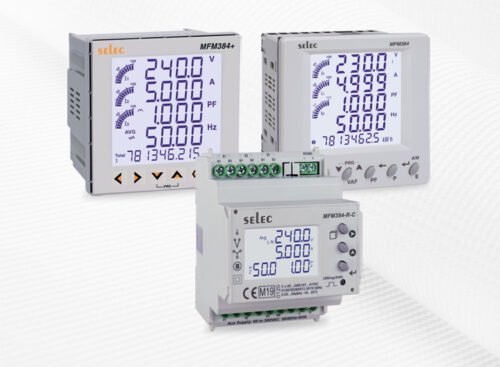 Digital Multifunction Meter