

Prevent, Verify and Improve: Integrating Occupancy-Based AC Automation with Energy Monitoring for Energy-Conscious and Operationally Efficient Workplaces
In today’s business environment, organizations are under increasing pressure to improve operational efficiency, reduce energy costs, and demonstrate a commitment toward sustainability. This challenge is particularly relevant in commercial office spaces where heating, ventilation and air-conditioning (HVAC) systems account for a significant portion of the overall electricity consumption.
While many organizations invest heavily in efficient lighting, energy-efficient equipment, and sustainable building practices, a surprisingly large amount of energy is still lost through day-to-day operational inefficiencies. Air conditioners continue operating in unoccupied meeting rooms, cabins remain cooled long after employees have left, and equipment remains energized during weekends and holidays simply because no one remembered to switch it off.
For one leading financial services provider based in Mumbai, this issue had gradually become a matter of concern.
The organization had grown rapidly over the years. Its office infrastructure had expanded, air-conditioning systems had been added incrementally, and electricity costs had steadily increased. The management team increasingly felt that a considerable amount of energy was being consumed without a clear understanding of where, when, and why.
The objective was not merely to control air conditioners.
The objective was to build a workplace that consumed energy responsibly.
The Challenge
The facility management team identified several practical concerns:
- Air conditioners occasionally remained operational after office hours.
- Meeting rooms and cabins were often cooled despite being unoccupied.
- There was limited visibility into actual energy consumption patterns.
- Management lacked objective information to verify whether energy-saving initiatives were producing measurable results.
- There was no practical mechanism to identify abnormal energy consumption during non-operational hours.
Initially, the discussion centered around a familiar requirement:
“Can we centrally monitor and control all the air conditioners in our office?”
At first glance, centralized control appeared to be the obvious solution.
A dashboard could indicate which air conditioners were operating, and an administrator could remotely switch them off whenever required.
However, a deeper evaluation revealed an important question. Was centralized control the objective? Or was it merely one possible method of achieving a larger objective?
Looking Beyond Remote Switching
In most commercial offices, the real objectives are remarkably simple:
- Prevent unnecessary AC operation.
- Reduce avoidable energy costs.
- Improve operational discipline.
- Increase visibility into energy usage.
- Encourage responsible energy practices.
A purely centralized approach often remains reactive. An air conditioner continues operating until:
- Someone notices it.
- Someone remembers to take action.
- Someone is available to switch it off.
In practice, unnecessary energy consumption can continue whenever these conditions are not met. The organization therefore decided to explore a more proactive philosophy.
Instead of asking: Who will switch the AC OFF?
The better question became: Why should the AC continue running if nobody is using the room?
Understanding the Existing Infrastructure
The office had approximately thirty-five air-conditioning units of varying capacities, distributed across cabins, meeting rooms and open office areas.
The objective was not to replace existing infrastructure. The objective was to make the existing infrastructure operate more intelligently. An assessment of the electrical infrastructure and energy consumption patterns indicated that:
- Air-conditioning represented a meaningful share of electricity consumption.
- Energy usage patterns varied considerably during different periods of operation.
- Overall electrical health was satisfactory.
- There existed an opportunity to improve operational visibility and identify avoidable energy consumption.
The findings suggested that the organization did not necessarily need an elaborate building management system. Instead, it needed a practical and scalable approach.
A Different Philosophy – Prevent, Verify and Improve
The solution eventually evolved around three simple principles.
- Prevent: Prevent unnecessary equipment operation before energy is wasted.
- Verify: Continuously verify actual performance through independent energy monitoring.
- Improve: Use operational information to continuously improve energy management practices.
This philosophy eventually became the foundation of the project.
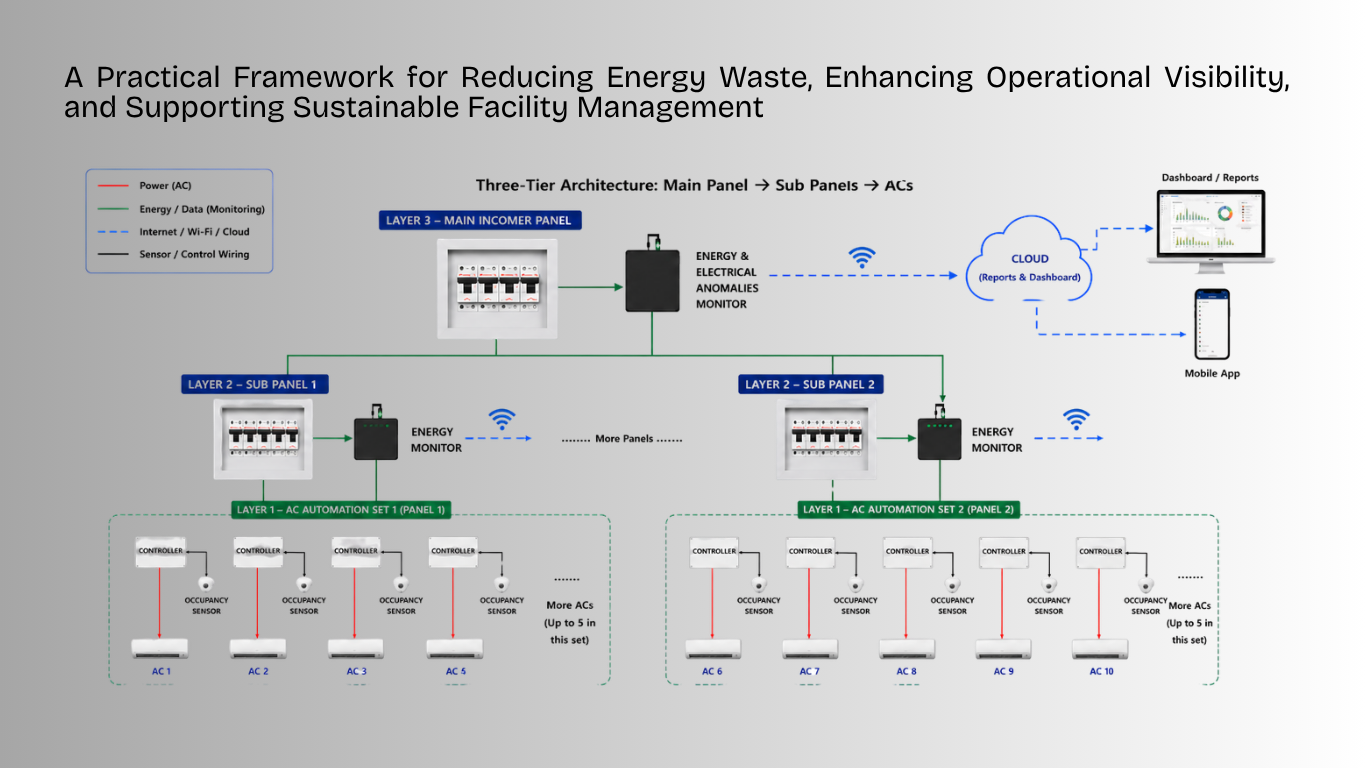
Layer 1 – Preventive Occupancy-Based AC Automation
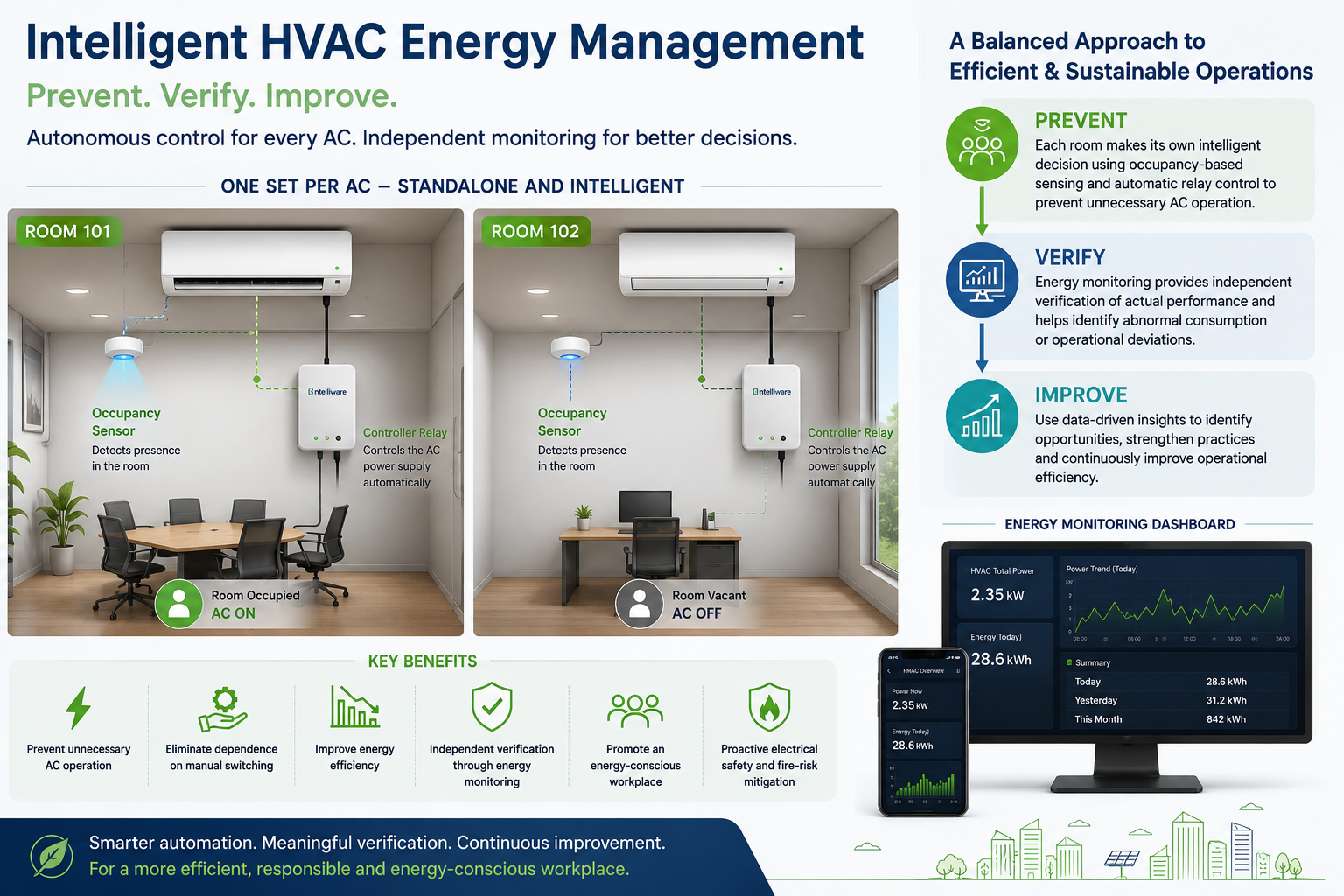
The first layer of the solution focused on preventing unnecessary operation.
Each air conditioner was paired with:
- An occupancy sensor.
- A dedicated controller.
- Automatic switching logic.
Whenever the space remained occupied, the air conditioner continued operating normally. However, when the room remained vacant beyond a predefined period, the system automatically disconnected the air conditioner without requiring any human intervention. The benefits of this approach were immediately apparent.
The automation continued to function:
- During office hours.
- After office hours.
- During weekends.
- During holidays.
- Even when nobody was actively monitoring the system.
The responsibility of remembering to switch equipment off was transferred from people to the system itself. The objective shifted from manual supervision to automatic prevention.
Why Local Automation Makes Sense
Many organizations instinctively gravitate toward centralized control. However, local autonomous automation offers several practical advantages.
- Continuous Operation: The system remains functional regardless of whether anyone is watching a dashboard.
- Reduced Dependence on Human Intervention: Routine operational decisions become automated.
- Scalability: Each room becomes independently intelligent.
- Simplicity: No complex building management infrastructure is required.
- Better User Acceptance: Employees continue using the air conditioners normally without significant changes to their routine.
The automation quietly eliminates unnecessary energy consumption in the background.
Layer 2 – Verification Through Energy Intelligence
Preventive automation alone is not sufficient. Any engineering initiative must be independently verifiable. The organization therefore introduced a second layer.
Energy monitoring was installed at selected electrical distribution points to continuously monitor:
- Energy consumption.
- Operating trends.
- After-hours consumption.
- Section-wise loading patterns.
This additional layer answered several important questions.
- Are HVAC circuits consuming energy after office hours?
- Are shutdown procedures being followed?
- Are energy-saving initiatives producing measurable results?
- Is there any unusual overnight consumption requiring investigation?
The objective was not to supervise individuals. The objective was to improve operational efficiency through objective, measurable information.
Building Operational Visibility
Energy monitoring created something the organization previously lacked: Visibility.
The management team could now understand:
- How the facility consumed energy.
- When consumption increased.
- Which sections exhibited unusual behaviour.
- Whether operational practices were improving over time.
This visibility gradually transformed the conversation around energy. Energy consumption was no longer an abstract monthly electricity bill. It became measurable information that could support informed decisions.
Beyond Energy Savings
An interesting realization emerged during the implementation. The same monitoring infrastructure provided benefits beyond HVAC management. The organization could now:
- Detect unusual energy consumption during non-operational hours.
- Verify shutdown procedures.
- Identify equipment inadvertently left energized.
- Observe unusual loading patterns requiring investigation.
- Improve overall electrical visibility.
The monitoring infrastructure also provided an additional layer of electrical safety awareness by helping identify unexpected consumption patterns that may warrant investigation.
The project therefore evolved from an AC automation initiative into a broader operational intelligence initiative.
Building an Energy-Conscious Workplace
Technology alone does not reduce energy consumption.
People do.
Technology simply makes responsible behaviour easier to achieve. Automation eliminated avoidable wastage.
Energy monitoring created visibility. Visibility created awareness. Awareness gradually encouraged responsible operational practices throughout the organization. Employees became more conscious of equipment usage. Facility teams became more aware of consumption patterns. Management gained objective information to support better decisions. Over time, energy efficiency evolved from an occasional initiative into an organizational practice.
Why the Combination Works
The project demonstrated an important principle. Neither technology alone is sufficient. Automation without monitoring lacks verification. Monitoring without automation remains reactive.
However, when both approaches are combined:
- Waste is prevented.
- Performance is verified.
- Improvement becomes measurable.
The organization effectively created a continuous improvement loop.
Prevent: Prevent unnecessary operation.
Verify: Measure actual performance.
Improve: Use information to optimize operations.
This simple framework became the foundation of a practical and sustainable energy management strategy.
Supporting Sustainability Objectives
Sustainability is often perceived as a large and complex initiative involving renewable energy, carbon accounting, and green certifications. However, sustainable operations frequently begin with much simpler questions.
- Are we using energy responsibly?
- Are we consuming energy only when required?
- Do we understand how our facilities actually consume electricity?
- Can we continuously improve?
The integration of occupancy-based AC automation and energy monitoring helped answer these questions. The organization was able to:
- Reduce avoidable energy consumption.
- Improve operational efficiency.
- Enhance visibility into energy usage.
- Encourage responsible operational practices.
- Strengthen sustainability initiatives.
A Practical Framework for Modern Workplaces
The experience of this Mumbai-based financial services organization demonstrates that intelligent facility management does not always require large and complex building management systems.
Often, practical and measurable improvements can be achieved through a combination of:
Preventive Automation: Automatically eliminate unnecessary equipment operation.
Energy Verification: Continuously verify performance through objective information.
Continuous Improvement: Use operational insights to improve efficiency and support sustainability.
The result is an energy-conscious and operationally efficient workplace where responsible energy usage becomes part of everyday operations.
Lessons from the Experience
Every organization wants to reduce energy costs. Every organization wants better operational visibility. Every organization wants to become more sustainable.
The challenge lies in transforming these aspirations into practical and measurable actions.
The combination of occupancy-based AC automation and energy monitoring offers one such practical framework. By integrating local automation with energy intelligence, organizations can:
- Prevent unnecessary AC operation.
- Reduce avoidable energy consumption.
- Improve operational visibility.
- Verify the effectiveness of energy-saving initiatives.
- Encourage responsible energy practices.
- Support sustainability objectives.
- Build energy-conscious and operationally efficient workplaces.
Ultimately, the objective is not merely to automate air conditioners.
The objective is to create an operating environment where energy is used intelligently, measured continuously, and improved systematically.
Starting the Conversation
At Intelliware, we believe that every facility has an opportunity to improve the way it uses energy.
Whether your objective is to reduce electricity costs, improve operational visibility, automate routine energy decisions, or build a more sustainable workplace, the first step is often to understand how energy is actually being used.
If your organization is exploring initiatives related to HVAC automation, energy monitoring, or intelligent facility management, we would be pleased to engage with your team, understand your objectives, and evaluate practical approaches that deliver measurable value.
Because sustainable energy management does not begin with technology alone. It begins with asking the right questions, understanding the existing operating practices, and implementing solutions that help organizations continuously Prevent, Verify and Improve.
Wish to learn more about the solution and discuss similar challenges at your facility, please feel free to connect Intelliware team:
- Call/SMS/WhatsApp: +91 8279921905
- email: contactus@intelliware.in
- Facebook: https://www.facebook.com/intelliware.in
- LinkedIn: https://linkedin.com/company/intelliware-in
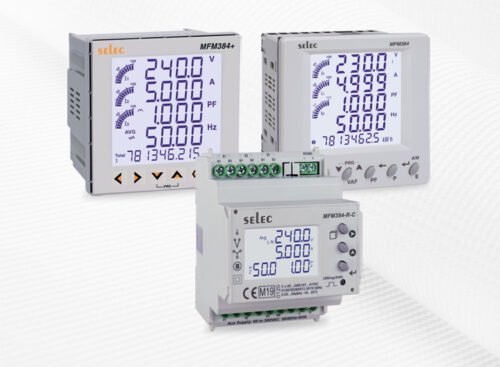 Digital Multifunction Meter