

Responsible AI Infrastructure: Operational Resilience, Energy Intelligence, and ESG-Driven Infrastructure Management
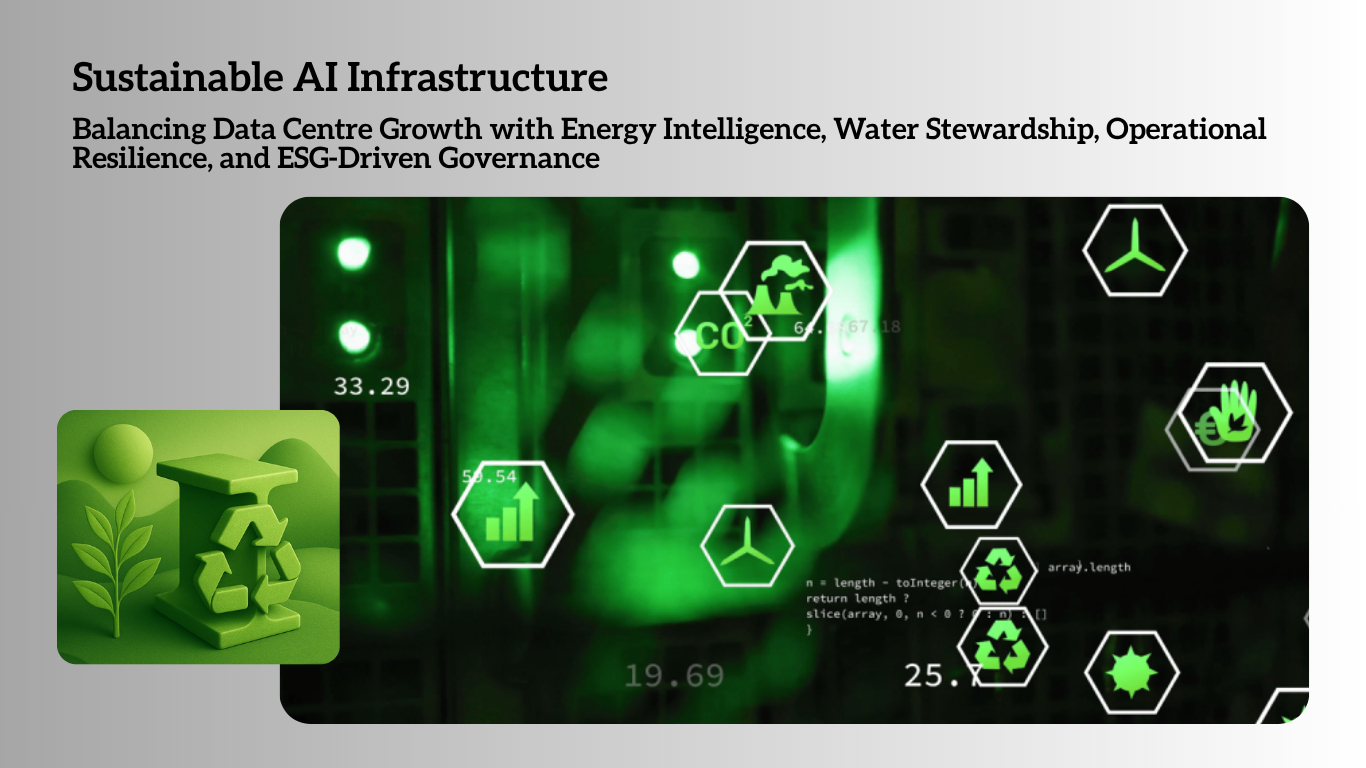
The global data centre industry is entering one of the most important transitions in its history. Artificial intelligence, cloud computing, digital banking, streaming services, industrial automation, telecom ecosystems, and real-time analytics are driving unprecedented demand for digital infrastructure across the world. Governments and enterprises are investing aggressively in hyperscale facilities, edge infrastructure, and AI-ready computing environments because digital capability is increasingly linked with economic growth, industrial competitiveness, and technological leadership.
India is also emerging as a major destination for data centre expansion. The rapid growth of cloud adoption, AI deployment, fintech ecosystems, smart manufacturing, digital governance, and connected industrial systems is accelerating investments across the country. What was once viewed as supporting IT infrastructure has now evolved into a foundational operational layer supporting industries, financial systems, healthcare platforms, logistics networks, communication ecosystems, and modern public services.
However, as infrastructure demand accelerates, the industry conversation is also beginning to evolve.
For years, data centre discussions largely revolved around:
- uptime,
- redundancy,
- computational capability,
- and network reliability.
Today, the expectations are much broader.
Modern infrastructure operators are increasingly being evaluated on:
- operational resilience,
- sustainability performance,
- energy efficiency,
- water stewardship,
- cybersecurity maturity,
- infrastructure governance,
- environmental accountability,
- and long-term operational transparency.
This shift reflects an important reality: modern AI infrastructure is not only a digital ecosystem. It is also a highly resource-intensive physical infrastructure environment operating continuously under demanding electrical and thermal conditions.
Behind every AI model, digital transaction, cloud application, streaming platform, or industrial automation system lies an extensive operational ecosystem dependent on:
- uninterrupted power supply,
- cooling infrastructure,
- electrical reliability,
- water availability,
- intelligent monitoring systems,
- protection and control infrastructure,
- fire safety systems,
- and continuous operational visibility.
As AI workloads become more compute-intensive, these dependencies are growing rapidly. High-density GPU environments generate enormous thermal loads and demand stable operating conditions around the clock. This is pushing data centres toward higher power densities, larger cooling requirements, stronger utility dependencies, and increasingly sophisticated operational management practices.
The Shift from Uptime to Trusted Infrastructure
Historically, data centre success was measured primarily through uptime and availability. If facilities remained operational and downtime was minimized, infrastructure was considered successful.
That definition is now changing.
As digital infrastructure becomes increasingly integrated with economic systems and societal functions, stakeholders expect operators to demonstrate far more than operational continuity. Enterprises, regulators, investors, customers, and communities now expect infrastructure providers to balance:
- reliability,
- sustainability,
- governance,
- operational transparency,
- environmental responsibility,
- and long-term resilience.
The industry is therefore gradually evolving from the idea of “high availability infrastructure” toward the broader concept of “trusted infrastructure.”
This transition is being influenced by several parallel developments:
- rapid AI-driven infrastructure expansion,
- increasing power and cooling intensity,
- rising ESG expectations,
- growing sustainability scrutiny,
- regulatory reporting pressures,
- and concerns around long-term resource utilization.
Operational trust is no longer defined solely by uninterrupted service. Increasingly, it depends on whether infrastructure systems are:
- resilient,
- resource-efficient,
- intelligently monitored,
- environmentally responsible,
- and sustainably governed.
The Physical Reality Behind AI Infrastructure
Although AI and cloud ecosystems are often discussed in digital terms, the operational reality behind them is deeply physical.
Modern data centres rely on continuous coordination between:
- electrical distribution systems,
- transformers and switchgear,
- UPS systems and battery banks,
- DG backup infrastructure,
- cooling towers and chillers,
- ventilation and thermal management systems,
- pumps and water treatment systems,
- intelligent automation platforms,
- fire detection and suppression systems,
- environmental monitoring infrastructure,
- and centralized operational control systems.
Maintaining stable operating conditions across such environments requires enormous synchronization between digital workloads and physical infrastructure.
Even small disturbances involving:
- power quality,
- voltage stability,
- harmonics,
- thermal performance,
- cooling efficiency,
- or electrical protection
can affect infrastructure reliability and operational continuity.
This is why operational resilience in modern data centres increasingly depends on:
- intelligent energy measurement,
- real-time infrastructure visibility,
- power quality analytics,
- predictive maintenance,
- automated control systems,
- and integrated infrastructure monitoring.
Without operational visibility, infrastructure efficiency and resilience become difficult to sustain at scale.
Energy Management Is Becoming a Strategic Infrastructure Priority
Electricity remains the lifeblood of digital infrastructure. Data centres consume power not only for computing equipment, but also for cooling operations, battery charging systems, redundancy infrastructure, ventilation systems, lighting, environmental controls, and auxiliary operations.
AI-driven facilities are significantly increasing energy demand because high-density computational environments require continuous large-scale processing capability along with highly stable thermal conditions.
As infrastructure scales:
- utility demand rises,
- grid dependency intensifies,
- electrical infrastructure expands,
- and operational energy costs increase.
Utilities and policymakers in several regions are already evaluating how hyperscale infrastructure growth may influence:
- grid stability,
- transmission infrastructure readiness,
- backup power dependency,
- peak demand management,
- and long-term energy planning.
This is one of the key reasons why energy efficiency is no longer merely a sustainability objective. It is becoming a core operational and economic requirement directly linked with:
- infrastructure resilience,
- business continuity,
- cost optimization,
- ESG performance,
- and long-term infrastructure viability.
Modern facilities are therefore investing more heavily in:
- advanced energy metering,
- power quality monitoring,
- load analytics,
- harmonic analysis,
- intelligent load balancing,
- automated power management,
- electrical anomaly detection,
- and centralized energy visibility platforms.
Real-time energy intelligence allows operators to move from reactive operations toward predictive and optimized infrastructure management.
Water Stewardship Is Emerging as a Critical ESG and Operational Issue
As AI workloads increase thermal intensity, cooling infrastructure is becoming one of the most important operational dimensions of modern data centres. Many cooling architectures depend directly or indirectly on water for heat rejection and thermal stabilization.
This has increased industry focus on:
- cooling-related water demand,
- evaporative losses,
- thermal efficiency,
- sustainable cooling practices,
- and regional water dependency.
In water-stressed regions, concerns are naturally growing around:
- industrial water utilization,
- long-term sustainability,
- community impact,
- and responsible resource allocation.
The issue, however, is no longer limited to how much water is consumed. Increasingly, stakeholders are evaluating:
- how intelligently water systems are monitored,
- how efficiently cooling systems operate,
- how effectively water is recycled,
- and how transparently utilization practices are governed.
This is where ESG expectations and operational realities are beginning to converge.
Forward-looking operators are increasingly exploring:
- closed-loop cooling systems,
- treated water reuse,
- intelligent thermal management,
- hybrid cooling architectures,
- real-time water monitoring,
- and cooling optimization technologies.
Water stewardship is gradually evolving from a sustainability initiative into a core operational discipline.
Power Quality, Protection, and Control: The Invisible Layer of Data Centre Reliability
Modern AI infrastructure depends heavily on electrical stability. Sensitive computing environments require reliable and high-quality electrical conditions to maintain uninterrupted operations.
Disturbances such as:
- voltage fluctuations,
- harmonics,
- transients,
- frequency variations,
- phase imbalance,
- and electrical faults
can directly affect equipment performance and operational continuity.
As power densities rise, intelligent protection and control systems are becoming increasingly important for maintaining operational resilience.
Today’s facilities are placing greater emphasis on:
- intelligent protection relays,
- earth leakage monitoring systems,
- automatic transfer systems,
- breaker coordination,
- power factor management,
- centralized electrical monitoring,
- selective load management,
- and infrastructure automation systems.
Similarly, automated operational controls are helping operators improve:
- cooling coordination,
- backup infrastructure management,
- utility synchronization,
- load prioritization,
- and energy optimization strategies.
The future of resilient AI infrastructure will increasingly depend on how effectively operators integrate:
- measurement,
- monitoring,
- protection,
- automation,
- and operational intelligence
into a unified infrastructure management framework.
Fire Safety and Risk Management Are Becoming Strategic Operational Priorities
Modern data centres are high-density electrical environments operating continuously under thermal stress. As facilities become larger and more power-intensive, fire safety infrastructure is becoming increasingly critical not only from a compliance perspective, but also from an operational continuity standpoint.
Future-ready facilities increasingly depend on:
- intelligent fire detection systems,
- smoke and thermal monitoring,
- electrical fault detection,
- alarm management systems,
- suppression coordination,
- and integrated safety infrastructure.
The role of fire safety systems is gradually evolving from isolated compliance infrastructure into a critical component of business continuity and operational resilience planning.
ESG, BRSR, and the Rising Demand for Infrastructure Transparency
One of the biggest changes influencing the data centre industry today is the growing expectation around ESG accountability and sustainability transparency.
Large enterprises, infrastructure operators, investors, and regulators increasingly expect measurable visibility into:
- energy consumption,
- emissions intensity,
- water utilization,
- infrastructure efficiency,
- sustainability performance,
- and governance practices.
In India, evolving BRSR expectations are also accelerating focus on:
- environmental disclosures,
- operational transparency,
- resource utilization reporting,
- governance accountability,
- and sustainability-linked operational visibility.
This is fundamentally changing the role of infrastructure monitoring systems.
Technologies such as:
- energy meters,
- power quality analyzers,
- environmental monitoring systems,
- water monitoring platforms,
- automation systems,
- and centralized analytics dashboards
are no longer only operational tools.
Increasingly, they are becoming:
- ESG data sources,
- governance enablers,
- sustainability intelligence platforms,
- and infrastructure accountability systems.
As ESG and BRSR expectations mature, data centre operators may increasingly require auditable visibility into:
- energy performance,
- cooling efficiency,
- water utilization,
- infrastructure reliability,
- and operational sustainability metrics.
This is likely to make intelligent infrastructure monitoring an important component of future governance frameworks.
Responsible Governance Will Define the Next Phase of AI Infrastructure Growth
Technology alone cannot solve sustainability challenges if operational practices remain fragmented or reactive. Long-term resilience increasingly depends on how effectively organizations integrate:
- operational performance,
- resource visibility,
- infrastructure intelligence,
- environmental accountability,
- and strategic governance.
Modern infrastructure governance increasingly requires alignment across:
- operational resilience,
- cybersecurity,
- sustainability,
- compliance,
- business continuity,
- environmental responsibility,
- and infrastructure optimization.
Future-ready facilities are gradually moving toward:
- centralized infrastructure visibility,
- predictive operational analytics,
- integrated sustainability dashboards,
- automated cooling optimization,
- intelligent energy management,
- and real-time operational intelligence systems.
The next phase of digital infrastructure growth will likely reward organizations that can successfully balance:
- computational capability,
- operational resilience,
- energy efficiency,
- water stewardship,
- infrastructure safety,
- ESG accountability,
- and responsible governance.
The future of AI infrastructure does not need to become a conflict between technological advancement and environmental responsibility. In fact, the next generation of digital infrastructure may create opportunities for smarter utility systems, intelligent resource optimization, sustainable cooling technologies, renewable integration, and data-driven infrastructure management.
Ultimately, responsible digital infrastructure is not about limiting technological progress. It is about ensuring that the systems powering the future economy are themselves designed, monitored, protected, optimized, and governed with greater intelligence, resilience, efficiency, and accountability.
Discuss Your Data Centre Energy, Water, and Infrastructure Challenges with Intelliware
As AI infrastructure scales, operational resilience, energy visibility, water stewardship, power quality, and sustainability governance are becoming increasingly important across modern data centre environments.
If your organization is evaluating:
- energy monitoring and power quality solutions,
- electrical protection and infrastructure visibility,
- water and utility monitoring,
- operational intelligence platforms,
- ESG and BRSR-linked infrastructure reporting,
- or resilient infrastructure management practices,
the Intelliware team would be happy to discuss your operational objectives and infrastructure challenges.
Call / SMS / WhatsApp: +91 8279921905
Email: contactus@intelliware.in
 Digital Multifunction Meter