

Enhancing Fire Risk Management: Integrating Automated Continuous Monitoring Systems (ACMS) and Electrical Anomaly Monitoring
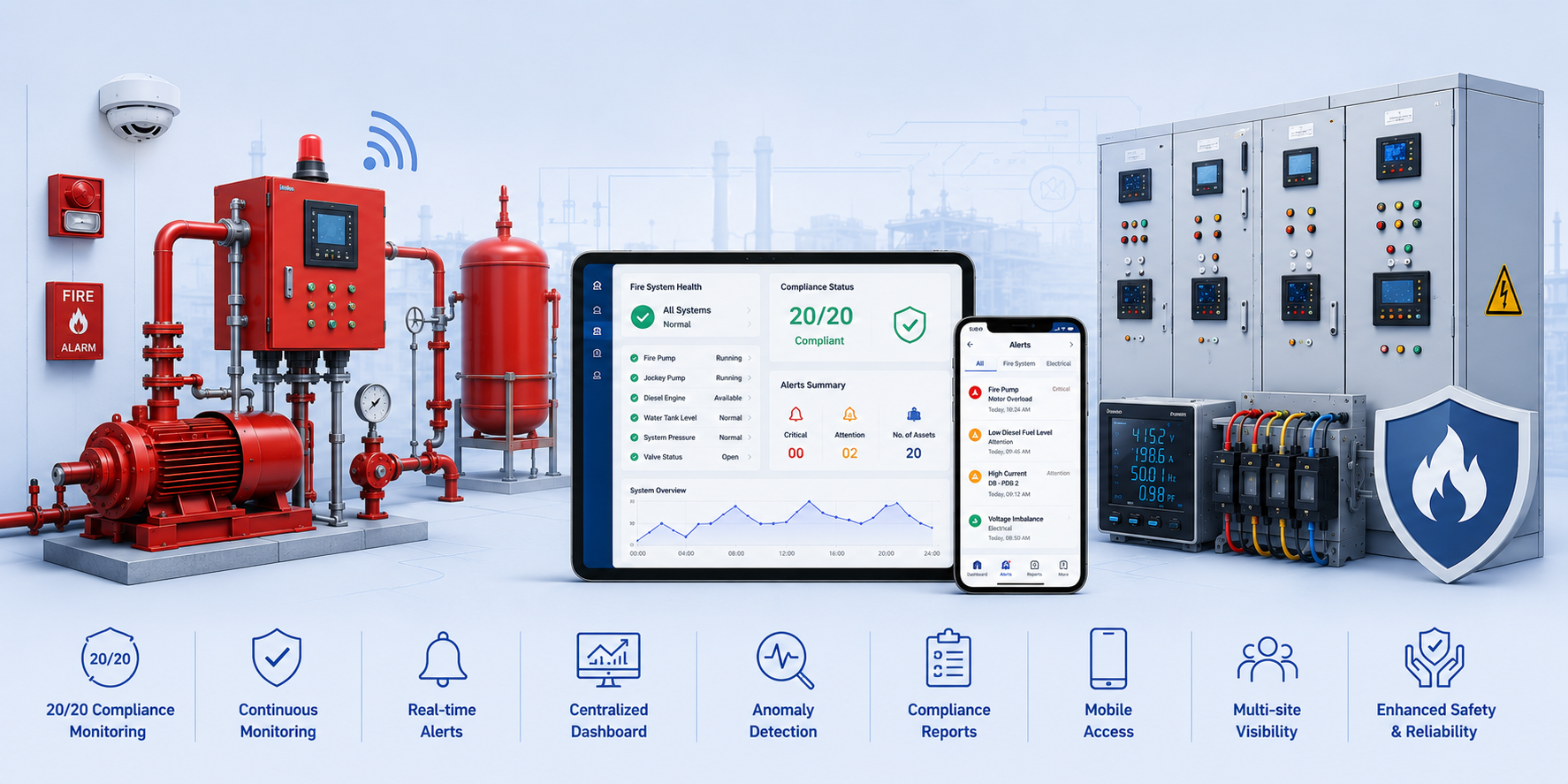
Fire Protection Systems Are Designed for Emergencies—But is their readiness monitored every day?
Fire protection systems are among the most critical life safety assets within any industrial, commercial or institutional facility. Whether it is a manufacturing plant, warehouse, hospital, educational campus, commercial complex or high-rise building, these systems are designed with one primary objective—to protect lives, property and business continuity when a fire emergency occurs.
Unlike production equipment, however, fire protection systems operate under a unique condition. They are expected to remain fully functional at all times, yet they may remain idle for weeks or even months. Fire pumps do not operate continuously, sprinkler systems remain pressurized without activation, diesel standby pumps remain on standby, and alarm systems silently supervise the facility waiting for an emergency that may never occur.
This very nature of fire protection systems creates a significant operational challenge.
Because these systems are seldom activated under real emergency conditions, their operational readiness is often assumed rather than continuously verified. A facility may appear fully protected while one or more critical components have silently become unavailable due to equipment failure, loss of power, inadequate water levels, communication faults or maintenance-related issues.
The real question therefore is not simply whether a fire protection system has been installed. The more important question is:
“If a fire emergency were to occur at this very moment, are all critical fire protection systems ready to respond?”
Traditionally, organizations have relied upon periodic inspection, preventive maintenance and statutory testing to answer this question. While these practices remain essential, they provide only a snapshot of the system’s condition at the time of inspection.
Modern fire risk management increasingly demands something more valuable—continuous operational visibility.
Recent regulatory developments have also reinforced this direction. TheMaharashtra Fire Prevention and Life Safety Measures Act, 2006 (as amended) introduces the requirement for an Automated Continuous Monitoring System (ACMS) for specified categories of buildings, reflecting the growing importance of continuously monitoring the operational readiness of fire protection infrastructure rather than relying solely on periodic verification.
Beyond regulatory compliance, Automated Continuous Monitoring Systems provide maintenance teams with timely information about abnormal operating conditions, enabling quicker investigation, faster corrective action and improved confidence that critical fire protection systems remain ready whenever they are needed.
At the same time, organizations are increasingly recognising another important aspect of fire risk. Many fire incidents originate from developing electrical abnormalities that may remain unnoticed until equipment fails or ignition occurs. Continuous monitoring of electrical anomalies therefore provides an additional layer of operational awareness, complementing the continuous monitoring of fire protection infrastructure.
This article explores how Automated Continuous Monitoring Systems (ACMS), together with Electrical Anomaly Monitoring, contribute towards a more proactive and informed approach to fire risk management.
Fire Safety Is More Than Installing Fire Protection Systems
For many organizations, fire safety begins with the installation of compliant fire protection systems. Fire hydrant networks, sprinkler systems, fire pumps, dedicated water storage tanks, fire alarm systems and smoke management systems are designed, installed, tested and commissioned in accordance with applicable standards and statutory requirements.
While installation is an important milestone, it should not be mistaken for operational readiness. A fire protection system continues to remain effective only when every critical subsystem remains available throughout its operational life.
Consider a typical industrial or commercial facility. Its fire protection infrastructure may include: Main Hydrant Pump, Main Sprinkler Pump, Standby Diesel Fire Pump, Jockey Pump, Booster Pump, Underground Fire Water Tank, Overhead Fire Water Tank, Fire Alarm Control Panel, Manual Call Points, Public Address System, Staircase Pressurization Fans, Basement Ventilation Systems etc…
Each of these systems performs a specific function during an emergency. If even one critical component becomes unavailable, the overall effectiveness of the fire protection system may be compromised.
For example:
-
- A discharged battery may prevent the standby diesel pump from starting.
- Low diesel fuel may render the standby pump unavailable during a prolonged emergency.
- Loss of power supply may disable the main hydrant or sprinkler pump.
- Low water levels in dedicated fire water storage tanks may reduce firefighting capability.
- Fire alarm panel faults may delay emergency detection and response.
- Failure of pressurization fans may compromise safe evacuation routes.
- Communication failures may prevent maintenance teams from becoming aware of developing issues.
Most of these abnormalities develop silently. They do not interrupt day-to-day operations, nor do they always produce visible symptoms. As a result, organizations often assume that their fire protection systems remain healthy simply because no emergency has occurred. This assumption can create a dangerous visibility gap between the actual condition of the system and the condition perceived by facility management.
Fire safety, therefore, is no longer defined only by the installation of compliant equipment. It increasingly depends upon the ability to continuously verify that critical fire protection systems remain operational and available throughout their service life.
Installing a fire protection system demonstrates compliance. Continuously monitoring its operational readiness demonstrates preparedness.
From Periodic Inspection to Continuous Operational Visibility
Inspection, testing and preventive maintenance have long been the foundation of fire safety management. Routine inspections verify equipment condition. Preventive maintenance restores equipment reliability. Statutory testing confirms compliance with applicable codes and standards. These practices remain indispensable and continue to form an essential part of every fire safety programme.
However, they also have an inherent limitation. They assess the condition of the system only at the time of inspection. Consider a practical example. A scheduled inspection is successfully completed on the 1st of the month, confirming that all monitored fire protection systems are functioning normally.
Now consider what happens if:
-
- The diesel pump battery charger fails on the 5th.
- The underground fire water tank level drops below the prescribed limit on the 9th.
- Electrical supply to the main hydrant pump is interrupted on the 14th.
- A fault develops in the fire alarm panel on the 18th.
These conditions may remain unnoticed until the next scheduled inspection. During this period, the organization continues operating under the assumption that its fire protection systems remain fully operational. This period between inspections represents a visibility gap that becomes increasingly significant in large industrial facilities, hospitals, commercial complexes and multi-building campuses where hundreds of critical assets require supervision.
Continuous operational visibility bridges this gap. Instead of relying solely on periodic inspections, facility teams receive timely information whenever predefined abnormal conditions occur, enabling maintenance personnel to investigate and rectify issues as they arise.
The philosophy changes from: “Inspect and verify periodically” to “Monitor continuously and intervene when required”
This approach does not replace preventive maintenance. Instead, it strengthens existing maintenance practices by reducing the duration for which abnormal conditions remain undetected.
Operational Perspective: Periodic inspection confirms the condition of the fire protection system at a particular point in time. Continuous monitoring helps maintain visibility into its condition between inspections.
Automated Continuous Monitoring Systems (ACMS): Enabling Continuous Fire System Health Monitoring
Recognising the need for continuous operational visibility, the Maharashtra Fire Prevention and Life Safety Measures Act, 2006 (as amended) introduces the concept of an Automated Continuous Monitoring System (ACMS) for specified categories of buildings.
Section 3(3A) of the Act requires that, for applicable buildings, the owner—or where the owner is not traceable, the occupier—shall ensure that the firefighting systems approved under the Fire Safety Approval are provided with an Automated Continuous Monitoring System (ACMS) to ensure that these systems remain in good repair and efficient working condition.
The emphasis of the legislation is significant. Rather than focusing only on installation or periodic inspection, the Act recognises the importance of continuously monitoring the operational status of critical fire protection infrastructure.
From an engineering perspective, an ACMS enables Automated Continuous Fire System Health Monitoring by continuously supervising predefined fire protection parameters, identifying abnormal operating conditions and communicating actionable information to authorised personnel

An ACMS typically supports:
-
- Continuous monitoring of critical fire protection assets.
- Automated detection of abnormal operating conditions.
- IoT-based data acquisition and communication.
- Real-time alerts and notifications.
- Centralised dashboards for facility-wide visibility.
- Historical event logs and audit records.
- Remote accessibility for authorised personnel.
By providing continuous visibility into the operational status of fire protection systems, maintenance teams can investigate abnormalities promptly rather than waiting for scheduled inspections to identify them.
It is important to recognise that an ACMS is not intended to replace preventive maintenance, statutory inspections or fire safety audits.
Instead, it complements these activities by providing continuous information between inspection cycles, enabling a more proactive approach to maintaining fire protection infrastructure.
20/20 Compliance Monitoring: Twenty Critical Fire Protection Parameters That Matter

An Automated Continuous Monitoring System delivers meaningful value only when it continuously supervises the critical assets that determine the operational readiness of the fire protection infrastructure.
Monitoring only fire pumps or water tank levels provides limited visibility. Likewise, monitoring only the fire alarm panel does not indicate whether adequate water pressure is available or whether the standby diesel pump is capable of starting during an emergency.
An effective ACMS therefore requires a comprehensive approach that monitors the complete firefighting ecosystem rather than isolated equipment.
The 20/20 Compliance Monitoring approach focuses on twenty critical parameters that collectively provide maintenance teams with continuous visibility into the health and availability of key fire protection systems.
Twenty Critical Fire Protection Parameters
| Sr. No. | Monitoring Parameter | Why It Matters |
| 1 | Main Hydrant Pump Status | Confirms availability of the primary hydrant pumping system. |
| 2 | Main Sprinkler Pump Status | Verifies readiness of the sprinkler pumping system. |
| 3 | Standby Diesel / Electric Pump Status | Ensures backup pumping capacity remains available during emergencies. |
| 4 | Jockey Pump Status | Maintains pressure within hydrant and sprinkler networks. |
| 5 | Booster Pump Status | Verifies operation of booster pumps where installed. |
| 6 | Diesel Tank Level | Ensures sufficient fuel for prolonged emergency operation. |
| 7 | Power Supply to Main Hydrant Pump | Detects interruption of electrical supply. |
| 8 | Hydrant Riser Pressure | Indicates readiness of the hydrant distribution system. |
| 9 | Power Supply to Main Sprinkler Pump | Confirms power availability to the sprinkler system. |
| 10 | Sprinkler Riser Pressure | Verifies operational pressure within sprinkler piping. |
| 11 | Underground / Fire Water Tank Level | Ensures adequate firefighting water reserve. |
| 12 | Overhead Fire Water Tank Level | Monitors emergency water availability. |
| 13 | Fire Alarm Panel Status | Supervises the operational health of the fire alarm system. |
| 14 | Repeater / Control Panel Status | Confirms communication and panel availability. |
| 15 | Fire Panel Battery Status | Verifies emergency backup power for the fire alarm system. |
| 16 | Manual Call Point Status | Detects activation or abnormal conditions. |
| 17 | Public Address (PA) System Status | Confirms readiness of emergency communication. |
| 18 | Staircase Pressurization Fan Status | Supports smoke-free evacuation routes. |
| 19 | Lift Lobby / Hoistway Pressurization Fan Status | Supports smoke management in lift areas. |
| 20 | Basement Supply & Exhaust Fan Status | Monitors basement smoke ventilation systems. |
Rather than waiting for routine inspections, ACMS continuously supervises these parameters and alerts maintenance personnel whenever predefined abnormal conditions are detected. This enables timely investigation and corrective action, helping ensure that critical fire protection infrastructure remains available whenever required.
The effectiveness of a fire protection system depends not on the health of one component, but on the collective readiness of all critical systems that support emergency response.
Electrical Anomaly Monitoring: Complementing Automated Continuous Monitoring Systems (ACMS)
An Automated Continuous Monitoring System helps ensure that the fire protection infrastructure remains operational and ready to respond. However, another important dimension of fire risk management deserves equal attention—the early identification of abnormal electrical conditions that may contribute to fire incidents.
Electrical distribution systems are the backbone of every modern facility. Motors, HVAC systems, process equipment, lighting, elevators, pumps, switchboards and distribution panels operate continuously throughout the day, often under varying load conditions.
Many electrical faults do not occur instantaneously. They develop progressively through abnormal operating conditions such as deteriorating insulation, overloaded circuits, loose connections, voltage fluctuations, harmonic distortion or earth leakage.
Conventional protective devices—including MCBs, MCCBs, ACBs, relays and fuses—are designed to disconnect circuits during severe fault conditions. While they play a vital role in electrical protection, they typically operate only after a fault reaches a predefined threshold.
Electrical Anomaly Monitoring provides an additional layer of operational intelligence by continuously monitoring developing abnormalities, enabling maintenance teams to investigate potential issues before they escalate into equipment failures or conditions that increase fire risk.
Typical Electrical Anomalies Monitored
| Electrical Anomaly | Purpose |
| Arcing | Detects abnormal electrical arcing conditions. |
| Short Circuit | Identifies fault conditions requiring immediate attention. |
| Over Current | Monitors excessive current beyond permissible limits. |
| Earth Leakage | Detects insulation deterioration and leakage currents. |
| Over Voltage | Identifies abnormal voltage rise affecting equipment. |
| Under Voltage | Detects low-voltage operating conditions. |
| Phase Loss | Monitors loss of one or more supply phases. |
| Phase Reversal | Detects incorrect phase sequence. |
| Loss of Supply to Neutral | Identifies neutral supply abnormalities. |
| Voltage Quality | Monitors voltage stability and quality. |
| Low Power Factor | Indicates inefficient electrical operation. |
| High Harmonics | Detects harmonic distortion affecting equipment reliability. |
| High Inrush Current | Monitors excessive starting current conditions. |
| Unbalanced Load | Identifies uneven phase loading. |
Unlike fire protection monitoring, Electrical Anomaly Monitoring focuses on identifying conditions that warrant engineering investigation and maintenance intervention. Together, these two monitoring approaches provide a broader understanding of fire risk from both the response and prevention perspectives.
How ACMS and Electrical Anomaly Monitoring Strengthen Fire Risk Management
Although both monitoring systems contribute towards safer facilities, they address different aspects of fire risk management.
| Automated Continuous Monitoring System (ACMS) | Electrical Anomaly Monitoring |
| Continuously monitors the readiness of fire protection systems. | Continuously monitors abnormal electrical operating conditions. |
| Focuses on emergency response preparedness. | Focuses on early detection of electrical abnormalities. |
| Monitors fire pumps, water tanks, alarm systems and associated infrastructure. | Monitors electrical faults, power quality and equipment behaviour. |
| Supports operational readiness and regulatory compliance. | Supports proactive electrical maintenance and operational reliability. |
| Helps ensure firefighting systems remain available. | Helps reduce the likelihood of electrical failures developing unnoticed. |
These monitoring approaches are complementary rather than independent. One confirms that fire protection systems remain capable of responding effectively during an emergency. The other provides early visibility into abnormal electrical conditions that may require investigation before they develop into larger operational or safety concerns. Together, they contribute to a more informed and proactive fire risk management strategy.
Operational Benefits Beyond Compliance
While regulatory compliance may initiate the adoption of an Automated Continuous Monitoring System, the operational advantages extend far beyond statutory requirements.
Organizations implementing continuous monitoring often realise benefits across maintenance, operations and risk management.
- Improved Operational Visibility: Maintenance teams obtain a centralised view of the health of critical fire protection assets without relying solely on manual inspections.
- Faster Maintenance Response: Real-time alerts enable timely investigation of abnormal conditions, reducing the period during which critical systems remain unavailable.
- Better Maintenance Planning: Historical trends and event logs support condition-based maintenance and help prioritise maintenance activities.
- Reduced Manual Inspection Effort: Routine status verification can be supplemented with continuous digital monitoring, allowing maintenance personnel to focus on corrective and preventive activities.
- Enhanced Documentation: Automatic event recording supports maintenance records, internal audits and compliance documentation.
- Improved Business Continuity: Maintaining the operational readiness of fire protection systems contributes towards reduced operational risk and greater organizational resilience.
Automated Continuous Monitoring Systems do not replace inspections, testing or preventive maintenance—they make these activities more effective by providing continuous operational visibility between inspection cycles.
Building Safer, Smarter and More Resilient Facilities
As industrial and commercial facilities continue to grow in size and complexity, maintaining operational visibility across critical infrastructure becomes increasingly important.
Automated Continuous Monitoring Systems support this objective by transforming scattered field information into actionable operational intelligence.
Combined with Electrical Anomaly Monitoring, facility teams gain greater awareness of both the readiness of their fire protection systems and the health of their electrical infrastructure.
The result is not merely improved compliance, but better-informed maintenance decisions, reduced operational uncertainty and stronger organisational resilience.
Ultimately, fire risk management is no longer defined only by how effectively an organisation responds to an emergency. It is equally influenced by how effectively it monitors, maintains and manages the systems designed to respond when that emergency occurs.
Fire protection systems are installed with the expectation that they will perform flawlessly when called upon. Achieving this objective requires more than periodic inspection—it requires continuous awareness of the operational status of the systems responsible for protecting lives and property.
The introduction of Automated Continuous Monitoring Systems (ACMS) under the Maharashtra Fire Prevention and Life Safety Measures Act reflects this evolving approach to fire safety management, placing greater emphasis on continuous operational visibility and system readiness.
Complementing ACMS with Electrical Anomaly Monitoring further strengthens fire risk management by providing early visibility into abnormal electrical conditions that may warrant timely investigation.
Together, these monitoring approaches help organisations move beyond reactive maintenance towards a more proactive strategy based on continuous monitoring, timely intervention and informed decision-making.
Planning an Automated Continuous Monitoring System (ACMS) for Your Facility?
Whether your objective is to comply with emerging regulatory requirements, strengthen fire safety, improve maintenance visibility or integrate electrical anomaly monitoring into your existing infrastructure, a structured assessment is the ideal starting point.
Intelliware assists industries, commercial establishments, healthcare facilities, educational institutions and infrastructure projects in planning and implementing Automated Continuous Monitoring Systems (ACMS) aligned with their operational requirements.
Our approach includes:
-
- Assessment of existing fire protection infrastructure
- Identification of critical monitoring points
- ACMS architecture and integration planning
- Electrical Anomaly Monitoring assessment
- Real-time dashboards, alerts and historical reporting
- Integration with existing Building Management Systems (BMS), SCADA and other monitoring platforms, wherever applicable
- Support during implementation and commissioning
If your organization is evaluating an Automated Continuous Monitoring System (ACMS) or looking to strengthen fire risk management through continuous operational visibility, our engineering team would be pleased to discuss your requirements and recommend a monitoring strategy aligned with your facility, operational objectives and applicable regulatory requirements.
Please feel free to connect:
- Call/SMS/WhatsApp: +91 8279921905
- email: contactus@intelliware.in
- Facebook: https://www.facebook.com/intelliware.in
- LinkedIn: https://linkedin.com/company/intelliware-in
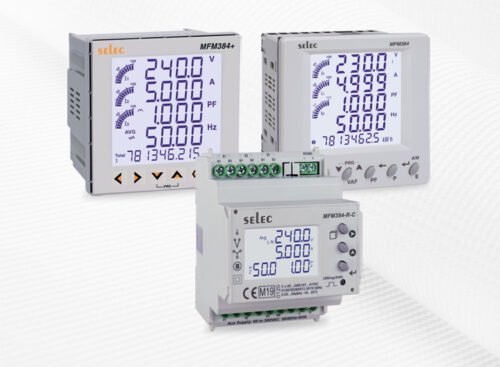 Digital Multifunction Meter