

CBG Quality Control: How Gas Analysis and Process Monitoring Improve Plant Performance
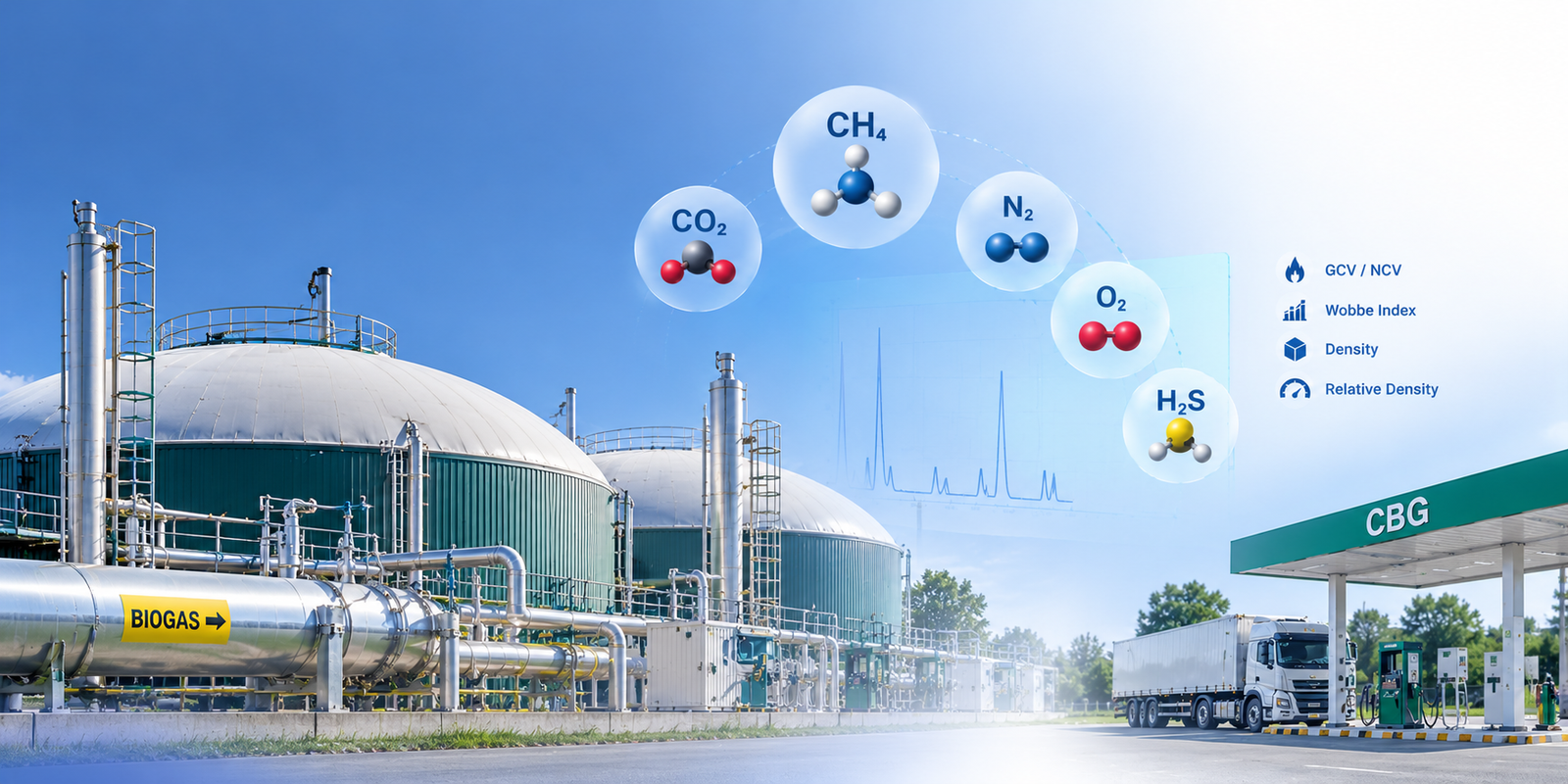
CBG Quality Control: How Gas Analysis and Process Monitoring Improve Plant Performance
The Operational Challenge: Producing Gas Is Not the Same as Producing Consistent-Quality Gas
A CBG plant may be producing gas every day, its compressors may be running normally, and its purification system may appear to be functioning as expected. Yet, the gas quality at the outlet can vary with feedstock composition, digester conditions, gas-cleaning performance and equipment condition.
This creates an important distinction between production performance and product quality.
Consider a plant processing organic waste into biogas. The raw gas contains methane, carbon dioxide, hydrogen sulphide, water vapour and other constituents in varying proportions. The gas must be treated, purified, dried and compressed before it can be supplied for automotive, industrial or other approved applications.
If the purification system does not consistently remove unwanted components, the plant may face several operational challenges:
- Methane concentration may fall, reducing the useful energy content of the gas.
- Hydrogen sulphide may exceed the acceptable limit, increasing corrosion risks and creating a safety concern.
- Residual moisture may cause condensation in downstream equipment, storage or gas delivery systems.
- Carbon dioxide and other non-combustible gases may affect fuel quality and calculated calorific value.
- Variations in gas composition may lead to inconsistent product quality and difficulty meeting customer acceptance requirements.
The problem is not necessarily a complete failure of the plant. It may be a gradual deterioration in one part of the process that remains unnoticed until a quality test fails, a customer raises a concern or equipment performance is affected.
For CBG operators, the objective should therefore be to establish a reliable relationship between gas quality, process conditions and equipment performance.
Where Do CBG Quality Problems Originate?
CBG quality is influenced by the entire process, from feedstock preparation and anaerobic digestion to purification, drying, compression and final delivery.
The following table connects common quality deviations with the operational areas that need attention.
| Quality parameter | Why it matters | Potential process or equipment concern |
|---|---|---|
| Methane (CH₄) | Determines the principal combustible component of CBG | Digester performance, feedstock variation or inadequate purification |
| Carbon dioxide (CO₂) | Dilutes methane and affects fuel properties | Inadequate CO₂ removal, absorber performance or regeneration issues |
| Hydrogen sulphide (H₂S) | Corrosive and hazardous; must be controlled | Desulphurisation media exhaustion, inadequate treatment or breakthrough |
| Total sulphur | Indicates the overall sulphur burden, including relevant sulphur compounds | Ineffective sulphur removal or contamination from other sources |
| Moisture | Excess water can cause condensation and operational problems | Dryer performance, moisture carryover or ineffective condensate removal |
| Oxygen (O₂) | Indicates possible air ingress or a process-related deviation | Leakage, air ingress or an abnormal operating condition |
| Nitrogen (N₂) and other inerts | Dilute the useful gas components | Air ingress, feed-gas variation or process-specific causes |
| Siloxanes and other trace contaminants | Can damage sensitive downstream equipment in applications where these contaminants are relevant | Feedstock-dependent contamination and inadequate treatment |
Not every plant will face all these problems to the same extent. The risk profile depends on the feedstock, process configuration, gas-cleaning technology and intended end use.
Siloxanes, for example, deserve particular attention in certain wastewater-derived and other biogas applications because combustion can convert them into silica deposits. However, they should be treated as an application-specific analytical requirement, not automatically assumed to be a routine parameter in every CBG fuel-quality specification.
The important operational lesson is that a quality deviation should be investigated as a process problem, rather than treated only as a laboratory result.
Understanding the Quality Requirements: What Should a CBG Plant Monitor?
In India, the applicable quality specification is a critical starting point for designing a monitoring system. BIS has published IS 16087:2025, Biogas (Biomethane) — Specification (Second Revision). GAIL’s published quality table lists the following requirements under this standard. The plant should verify the applicable standard, customer contract and delivery requirements before finalising its acceptance limits. <Link url=”https://www.gailonline.com/cbgQualitySpecification.html” title=”GAIL CBG quality specifications”/>.
| Parameter | IS 16087:2025 requirement listed by GAIL |
|---|---|
| Methane (CH₄) | Minimum 95 mol% |
| Moisture | Maximum 5 mg/m³ |
| Hydrogen sulphide (H₂S) | Maximum 3.7 mg/m³ |
| Total sulphur, including H₂S | Maximum 10 mg/m³ |
| CO₂ + N₂ + O₂ | Maximum 5 mol% |
| Carbon dioxide (CO₂) | Maximum 4 mol% |
| Oxygen (O₂) | Maximum 0.5 mol% |
These limits illustrate why a single measurement cannot establish overall gas quality. A high methane reading does not, by itself, prove that moisture or sulphur levels are acceptable.
The quality-control programme should distinguish between three related but different requirements:
- Product acceptance: Does the delivered gas meet the applicable specification?
- Process control: Are the digestion, purification and drying systems operating within their intended performance range?
- Equipment protection: Are contaminants being controlled sufficiently to protect compressors, pipelines, storage systems and the end-use equipment?
The same parameter can serve more than one purpose, but the monitoring location, measurement frequency and alarm threshold may differ.
From Periodic Testing to Continuous Quality Monitoring
Periodic laboratory analysis remains valuable for verification, dispute resolution and measurement of parameters that are not covered by the installed online instruments.
However, periodic testing has an inherent limitation: it describes the sample collected at a particular time. If gas quality changes between sampling intervals, the plant may not identify the deviation immediately.
Online monitoring can close this gap.
A well-designed monitoring arrangement may use several measurement points, depending on the plant configuration:
Raw biogas → Purification stages → Treated gas outlet → Compressor and storage → Dispatch or delivery point
At these points, the operator can assess different aspects of performance.
Raw biogas monitoring
- Track incoming methane and carbon dioxide composition.
- Observe variations associated with feedstock and digestion conditions.
- Establish the inlet loading on the purification system.
Intermediate process monitoring
- Check whether the relevant purification stage is removing the intended contaminant.
- Identify deterioration in desulphurisation or CO₂-removal performance.
- Compare inlet and outlet concentrations where appropriate.
Treated gas and dispatch monitoring
- Verify the composition of the product gas.
- Detect deviations before they become repeated dispatch or acceptance problems.
- Maintain a record of quality trends alongside production and operating data.
A single analyser at the final outlet may help establish product composition, but it may not explain why the quality has changed. Additional monitoring points should be selected where they provide useful diagnostic information.
The objective is not to install an analyser at every point. It is to measure the parameters that help the operator identify a deviation, locate its likely cause and take corrective action before the problem escalates.
Gas Chromatography: Understanding What Is Actually in the Gas
Gas chromatography (GC) is an established analytical technique for separating and quantifying the components of a gas sample.
In an online gas chromatograph, a representative sample is introduced into the analytical system. The components are separated through the configured columns and detected. The analyser then reports the concentrations of the components covered by its analytical configuration.
For a CBG plant, this can provide a more detailed picture of gas composition than a measurement of methane alone.
Depending on the selected detector and method, the analysis can cover:
- Methane, carbon dioxide, nitrogen and oxygen.
- Relevant hydrocarbons.
- Hydrogen sulphide and total-sulphur response, where the analyser is configured and validated for these measurements.
- Calculated gas properties, such as gross calorific value, net calorific value, density, relative density and Wobbe Index, where supported by the analytical configuration.
These calculated properties are useful because gas quality is not determined only by the concentration of methane. Fuel interchangeability, energy content and combustion behaviour can also depend on the overall composition.
For example, a change in methane concentration can alter the gas’s energy content. A change in the balance of other components may also affect calculated properties. Tracking these values helps operators understand the product being produced and supplied.
The analytical method must still be appropriate for the required measurement range, reporting units and acceptance criteria. Calibration, sample conditioning and verification against suitable reference methods remain essential.
An Example of Online CBG Quality Analysis
One relevant example for this application is the Thermo Fisher Scientific CBG TRACE GC 1110, a gas chromatograph configured for CBG and biogas quality monitoring.
According to the supplied technical brochure, the configuration includes:
- TCD (Thermal Conductivity Detector): Measurement of methane, carbon dioxide, nitrogen, oxygen and configured hydrocarbons.
- FPD (Flame Photometric Detector): Hydrogen sulphide and sulphur response at trace levels.
- Chromeleon software: Data acquisition, reporting and supported gas-property calculations.
- NGA calculations: Gross and net calorific value, density, relative density and Wobbe Index.
- Modbus TCP/IP communication: Transfer of gas concentrations, calculated properties, status and diagnostics to a PLC or DCS.
The brochure specifies a typical configured analysis time of at least five minutes, depending on the components being measured. It lists a methane peak-area repeatability of less than 0.5% RSD, with the component-specific measurement specifications subject to the stated analytical conditions.
The instrument is therefore relevant where the plant requires detailed gas composition analysis, calculated fuel properties and integration with an industrial control system.
However, an important distinction must be maintained: a gas chromatograph does not automatically replace every other gas-quality instrument.
The supplied configuration does not include an online moisture or humidity meter. Moisture measurement, additional drying arrangements and other application-specific analysers may therefore need to be evaluated separately. The brochure also specifies moisture protection in the sampling line, including a moisture trap and backflush arrangement; this is sample protection, not a substitute for measuring the moisture content of the delivered gas.
Similarly, the suitability of the selected configuration for a contractual acceptance test must be confirmed against the required analytical methods, measurement ranges and acceptance criteria.
Monitoring the Process, Not Just the Product
The greatest operational value comes when gas-quality data is considered alongside process information.
Suppose a plant records a gradual increase in carbon dioxide concentration at the treated-gas outlet. The analyser identifies the deviation, but the measurement alone does not establish its cause.
The operations and instrumentation teams can then review:
- Raw biogas composition and incoming gas load.
- Purification system pressure, flow and relevant operating conditions.
- Adsorbent or treatment-media condition, where applicable.
- Regeneration cycles or other technology-specific operating parameters.
- Trends in the outlet concentration following adjustments.
If hydrogen sulphide rises, the investigation may instead focus on the desulphurisation system, treatment-media condition, inlet sulphur loading or possible breakthrough.
If methane remains within its target range but moisture is high, the drying system and moisture measurement arrangement need separate attention. A composition analyser cannot be expected to diagnose a parameter it does not measure.
This is where instrumentation becomes part of operational management. The purpose is not simply to generate a number; it is to connect the number with the process condition that may have caused it.
Integrating the Analyser with PLC, SCADA or DCS
When online gas analysis is integrated with the plant control system, quality information becomes available to the teams responsible for operating and maintaining the plant.
The supplied TRACE GC 1110 brochure identifies Modbus TCP/IP communication for individual gas concentrations, calculated properties, status and diagnostics. Such data can be incorporated into a suitable PLC, SCADA or DCS architecture.
A practical implementation can include:
- Trend displays: Methane, CO₂, H₂S and other configured parameters over time.
- Alarm management: Alerts when measured values approach or exceed approved operating thresholds.
- Process correlation: Comparison of gas quality with flow, pressure, temperature and purification-system operating data.
- Event records: Time-stamped quality deviations, analyser status and operator actions.
- Quality reports: Records for internal review, customer discussions and applicable compliance requirements.
Alarm limits should be selected with reference to the relevant product specification, contractual acceptance criteria and normal process variation. Warning limits may be set below the final acceptance limit to give operators time to investigate, but they should not be confused with the formal product specification.
Where dispatch decisions depend on gas quality, any automatic diversion, isolation or release logic must be engineered and validated as part of the wider process-control and safety design. The analyser’s output should not be treated as a stand-alone safety function.
Turning Quality Data into Better Operational Decisions
A monitoring system becomes valuable when it helps the plant take the right action.
| Observed deviation | Initial investigation | Potential operational response |
|---|---|---|
| Methane concentration falls | Review raw-gas composition and purification performance | Investigate process conditions and gas-upgrading efficiency |
| CO₂ concentration increases | Review the relevant CO₂-removal stage | Check operating conditions and treatment-system performance |
| H₂S rises at the outlet | Compare inlet loading and treatment-stage performance | Inspect media condition, treatment capacity and breakthrough |
| Moisture exceeds the target | Verify the moisture measurement and sample conditions | Inspect the dryer, condensate handling and moisture-removal system |
| Quality fluctuates intermittently | Compare analyser readings with process events and sample-system status | Investigate transient operating changes, sampling issues and instrument condition |
| Calculated calorific value changes | Review the complete gas composition and analytical validity | Assess fuel quality, process stability and customer acceptance implications |
These are starting points for troubleshooting, not automatic diagnoses. The actual cause must be established using process data, instrument checks and the plant’s operating procedures.
Over time, historical data can help answer important questions:
- Which operating conditions are associated with quality deterioration?
- How consistently is the purification system performing?
- Are deviations linked to specific operating cycles or feedstock changes?
- How frequently does the plant approach its quality limits?
- Are maintenance interventions improving the stability of gas quality?
This information can support better maintenance planning, more informed process adjustments and more reliable quality management.
What Should Be Considered Before Selecting a CBG Quality Analyser?
The correct instrument depends on the application. A plant seeking basic methane indication has different requirements from a facility that needs detailed gas composition, trace sulphur analysis and calculated fuel properties.
Before finalising an instrumentation package, the project team should establish:
- Application: Raw biogas monitoring, purification-stage performance, treated CBG quality or dispatch verification.
- Measurement requirements: Required components, reporting units, detection limits and operating range.
- Compliance basis: Applicable BIS specification, customer requirements and recognised test methods.
- Sampling system: Sample pressure, flow, temperature, moisture protection, tubing and distance from the sampling point.
- Integration: Required communication protocol, PLC/DCS compatibility, data mapping and alarm handling.
- Calibration: Certified calibration gases, routine verification, calibration frequency and reference-method requirements.
- Operating environment: Ambient temperature, analyser location, enclosure and utility requirements.
- Additional instruments: Moisture measurement, pressure and temperature transmitters, flow measurement or application-specific trace-contaminant analysis, as required.
- Lifecycle support: Commissioning, operator training, consumables, calibration support and service availability.
The analyser should be selected only after these requirements are defined. The instrument, sampling system, calibration arrangement and control-system integration must work together as one measurement solution.
The Broader Opportunity for CBG Plant Operators
As India’s CBG sector develops, the need to establish consistent product quality creates opportunities beyond the supply of individual instruments.
Plants may require support for gas-quality assessment, online analytical systems, sample-conditioning arrangements, moisture measurement, process instrumentation, data integration and maintenance of the analytical system.
For plant owners, the business case for monitoring is operational: detect deviations earlier, understand purification performance, protect downstream equipment and improve confidence in product quality.
For maintenance and instrumentation teams, the opportunity is to move from responding to failed samples towards identifying deterioration before it becomes a recurring problem.
For project teams, the priority is to design the measurement and control architecture around the actual process and the required quality specification, rather than treating the analyser as an isolated equipment purchase.
A Practical Next Step with Intelliware
Intelliware works across instrumentation, measurement, monitoring and industrial process applications. For CBG projects, the starting point is to understand the plant’s process configuration, intended gas application, quality requirements and existing instrumentation.
Based on these details, the appropriate combination of gas analysis, moisture measurement, process instrumentation and control-system integration can be evaluated.
Planning a CBG quality-monitoring system? Share your plant capacity, process flow, gas-cleaning technology, required quality parameters and existing PLC/SCADA arrangement with Intelliware. These details help establish the measurement requirements and identify a suitable analytical and monitoring solution for your application.
 Digital Multifunction Meter