

Energy Governance at Multi-Store Retail: How Continuous Electrical Monitoring Reinforced Energy Budget Optimization and Operational Safety
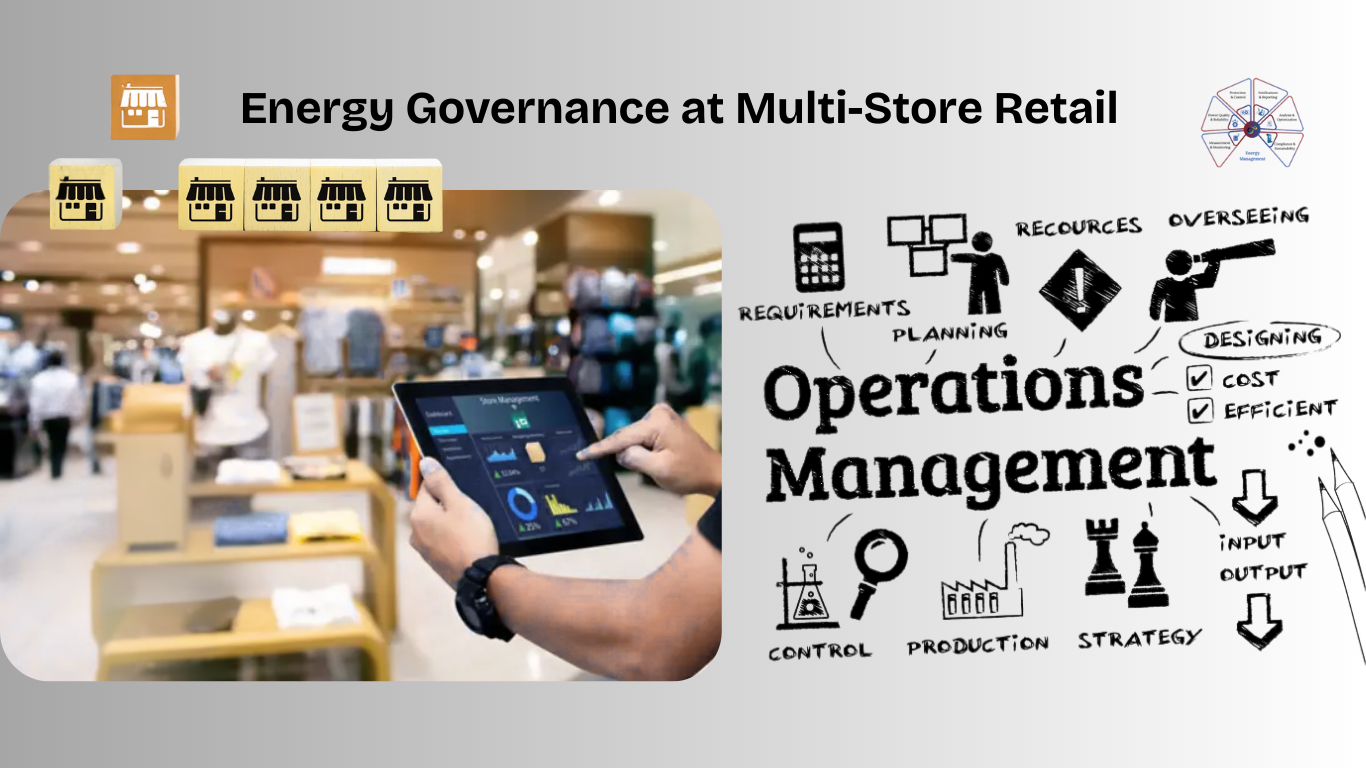
Managing energy across a large retail network is fundamentally different from managing it at a single site. At scale, even small inefficiencies repeat across hundreds of locations, turning minor issues into material cost and operational risk. This article draws from a real multi-store retail engagement and reflects how energy governance evolved on the ground, not in theory.
A leading fashion retail chain Headquartered in Delhi NCR operating over 500 stores across India and spanning multiple formats – from compact high-street outlets to large mall-based locations. Given the wide variation in store sizes, energy performance was reviewed in relation to store area, allowing management to compare electricity costs and consumption on a per-square-meter basis across the network. This framing made the economics unambiguous.
Rent remained the largest fixed cost at the store level. Electricity, however, consistently emerged as the second-largest operating expense – and unlike rent, it was one cost line where outcomes could be influenced through day-to-day operational discipline and faster corrective action.
As a result, annual energy budgets were no longer treated as passive financial allocations. They became an operational control parameter—closely linked to efficiency, accountability, and risk management across the retail network.
The Structural Limitation of Monthly Energy Data at Multi-Store Retail >
Despite the importance of electricity, the organization’s visibility into energy consumption was limited: energy data existed only as consolidated monthly electricity bills or random/time-based manual readings.
The periodic readings were helpful in a limited manner, and the bills served accounting purposes well, but they offered no operational insight. There was no visibility into how energy was consumed through the day, no way to identify deviation windows, and no linkage between operational practices and actual energy behavior at the store level. Standard operating procedures existed for HVAC schedules, Lighting and signage operation, and Refrigeration and critical equipment etc.
However, in-practice monthly bills could not verify whether these SOPs were being followed consistently. Any deviation—whether accidental, behavioral, or electrical—merged invisibly into aggregate consumption. By the time an overrun appeared in the bill:
- The inefficiency had already occurred
- The opportunity for timely correction had passed
Impact on Annual Energy Budgets and Accountability
The absence of granular electrical visibility had measurable business consequences. Over time, some stores began showing a gradual year-on-year drift in energy cost per square meter, while others triggered penalty charges without any obvious operational cause. As a result, budget forecasting became increasingly conservative, designed more to absorb uncertainty than to reflect actual performance. From a governance perspective, accountability was weak.
- Store managers lacked evidence to explain deviations
- Maintenance teams reacted only to failures or complaints
- Regional reviews relied on assumptions rather than facts
Energy discussions became retrospective rather than corrective.
Safety, Risk, and Compliance Considerations
Energy cost was not the only concern. Electricity also represented a compliance factor—linked to PF penalties, Scope 2 emission targets, load balancing and to a potential safety and fire risk if electrical anomalies went unnoticed. Even minor electrical disturbances that did not cause outages could contribute to inefficiency, stress equipment, and increase long-term risk. The absence of event-level electrical records also weakened internal audits, incident traceability, and compliance readiness. Effective energy management, therefore, required more than cost tracking; it required full visibility into electrical behavior.
Rethinking the Approach: Establishing an Energy Data Baseline
During the course of engagements, the organization recognized that the first step towards an effective energy governance is to establish data availability and credibility.
Until this point, energy information existed only as consolidated monthly bills and fragmented energy readings. To move beyond assumptions, the first step was clearly defined:
- Capture actual energy consumption data
- Generate consistent reports across selected stores (most prospective and impacted…)
- Compare energy behaviour across formats and regions
- Use analysis to highlight:
- Operational inefficiencies
- Wastage patterns
- Accountability gaps
- Adherence to defined operating practices
This phase prioritized creating a consistent and trustworthy energy dataset, forming the basis for more advanced analysis and decisions going forward.
Energy Monitoring, Reporting, and Analysis: A Proof of Concept >
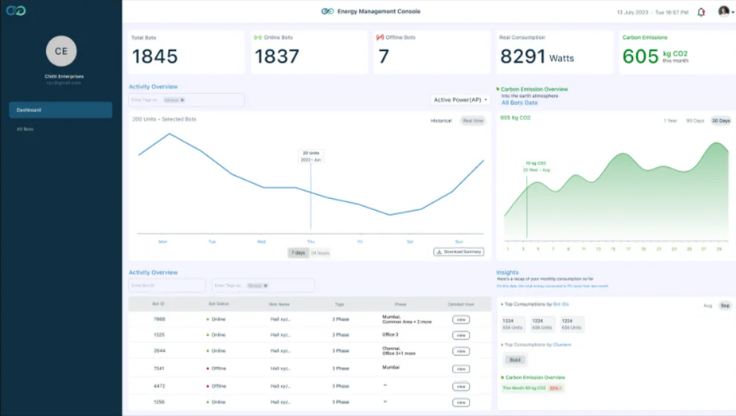
The decision to introduce structured energy monitoring did not begin with a technology deployment. It began with engagement.
The team worked closely with the retail organization’s maintenance and operations teams to understand how energy was being reviewed, discussed, and acted upon at the store level. While electricity costs were visible through monthly bills, there was no operational data available to explain why certain stores consistently exceeded expectations or where inefficiencies were originating.
The Manager- Retail Operations and Maintenance, local energy champion and the staff were clear on their expectations:
- Any initiative had to demonstrate measurable impact
- Insights needed to translate into operational action
- The solution had to support productivity, accountability, and cost control
- Return on investment had to be reinforced before scale-up
Based on these discussions, a clear line of action was finalised.
Rather than deploying across multiple locations immediately, the team agreed to start with a single store as a Proof of Concept – the electricity activity tracker devices were installed at the store in Delhi-West, where energy impact, operational complexity, and visibility were highest. The objective was to capture reliable energy data, generate structured reports, and analyze patterns that could highlight inefficiencies, deviations from operating practices, and accountability gaps.
This approach allowed the maintenance team and management to evaluate:
- Whether granular energy data added operational value
- How insights could influence corrective actions
- The relevance of energy data in improving overall equipment effectiveness (OEE)
- The feasibility of using such data to govern annual energy budgets at scale
The POC was therefore considered as a decision-support exercise, not just another technology trial.
Outcomes of the Energy Monitoring POC
The POC delivered clear, defensible outcomes. Deviations were identified with evidence rather than assumptions, conversations shifted from explanation to correction, and accountability improved through data-backed reviews. Most importantly, the organisation gained clarity that energy inefficiencies were not always equipment-related, and that behavioural and operational factors played a significant role. It also became evident that reliable data could directly support annual energy budget optimisation and allow energy behaviour to be compared consistently across stores.
Key POC insights included:
- Behavioural and operational factors contributed as much to inefficiency as equipment issues
- Granular data enabled comparisons across stores
- Annual energy budgets could be linked to operational actions rather than just financial allocations
These findings validated energy monitoring as a meaningful decision-support tool rather than a passive reporting mechanism.
Implications of the POC: Energy Budget Control and Governance Readiness
With behavioral energy data available during the POC period, the user maintenance team observed how annual energy budgets could move from being aspirational targets to operationally manageable controls.
The data demonstrated the potential to identify energy drift early, narrow wastage windows, reduce penalty-triggering conditions, and improve forecasting accuracy. Importantly, these improvements were achievable without changes to store formats or equipment specifications. The expected gains were linked to discipline, visibility, and faster corrective response.
These observations reinforced the role of energy monitoring as a foundational element of energy governance.
Expanding the Scope: Consideration of Advanced Electrical Capabilities
With energy monitoring validated as a baseline, the maintenance and operations teams began evaluating the next layer of capabilities. These included:
- Power quality monitoring
- Electrical anomaly detection
- Event reporting and notifications
- Isolation triggers through external protection devices
The goal was to understand how advanced electrical visibility could address inefficiencies, enhance operational safety, and strengthen risk and compliance readiness. This phased evaluation ensured that advanced capabilities would be introduced only after a credible data foundation was established.
Forward Rollout Consideration and Retail-Scale Governance
Based on POC learnings, the organisation recognised the potential value of standardised electrical visibility, noting that it could enable fair comparison across stores, provide common reference points for regional and corporate teams, and support fact-based energy discussions at scale.
Rollout strategy planned in phases:
- Start with 10–20 stores
- Scale across the existing 500+ stores
- Integrate into upcoming 1000+ stores
The objective was to embed energy governance into routine operations rather than treating it as a periodic review.
Key Learnings
Continuous electrical monitoring demonstrated the potential to:
- Reinforce annual energy budget optimisation
- Improve operational safety
- Strengthen compliance and audit readiness
Energy was no longer a monthly surprise, and electrical risk was no longer invisible. At retail scale, governance begins with visibility — and visibility begins at the electrical monitoring level
~ If you wish to learn more about the solution and discuss similar challenges at your retail stores, please feel free to connect intelliware team:
- Call/SMS/WhatsApp: +91 8279921905
- email: contactus@intelliware.in
- Facebook: https://www.facebook.com/intelliware.in
- LinkedIn: https://linkedin.com/company/intelliware-in