

Irrigation Water Behavior: Its Impact on System Performance, Soil Moisture, and Plant Function
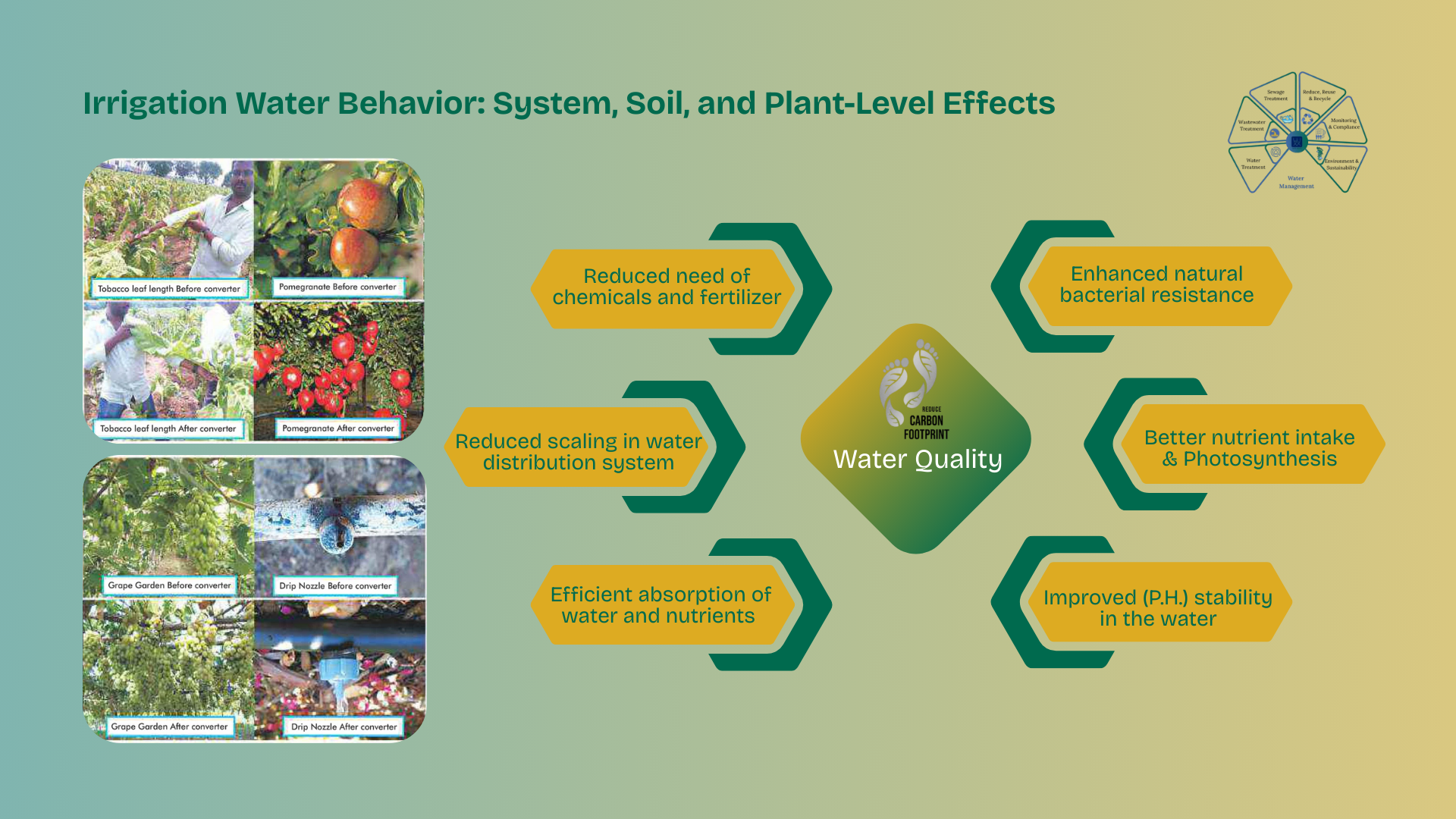
Agriculture today faces one of its most pressing challenges: achieving ever-higher productivity with limited and deteriorating water resources. In this context, irrigation infrastructure and water quality become strategic determinants of success. Hard water—rich in dissolved calcium and magnesium ions—can degrade irrigation systems through scaling, reduce water absorption in soils, and adversely affect crop health. ISS (Instant Solvent Softener) technology offers a non-chemical, maintenance-free solution that transforms water characteristics for agricultural environments, boosting efficiency and yield while reducing system wear and operating costs.
In this article, we unpack how ISS delivers agricultural value through nine focused dimensions used across our Intelliware blog series: challenge, mechanism, technical impact, crop benefit, irrigation systems, operational efficiency, sustainability, farmer economics, and field evidence.
1) Agricultural Water Quality Challenge
Agricultural water is frequently sourced from wells, canals and reservoirs where mineral dissolution leads to significant hardness. Hard water causes calcium carbonate to precipitate as scale in irrigation piping, pumps and emitters—especially in drip and sprinkler systems—leading to blockages, reduced flow, and increased power consumption. On the crop side, calcium deposits on roots and leaves act like a coating that impedes efficient water uptake and photosynthesis.
Systemic Consequences
- Scale buildup restricts water distribution and increases energy use.
- Poor soil water penetration reduces irrigation efficiency.
- Elevated chemical inputs (fertilisers, wetting agents) become necessary to compensate.
- Bacterial growth and biofilm propagation further diminish system performance.
2) What is ISS & How It Works

ISS—also known by product names such as Swachh Paani converter—is a non-chemical water treatment system that alters water behaviour to suppress scale formation rather than remove minerals from the water. Unlike conventional ion-exchange softeners that replace calcium/magnesium with sodium (which can be harmful to soils), ISS preserves essential mineral content while conditioning the water to prevent scale crystal adhesion.
At its core, ISS uses engineered turbulence and flow dynamics to encourage calcium carbonate to form non-adhesive crystal structures that remain suspended instead of depositing on surfaces. This process reduces the tendency of hard waters to form scale while improving overall flow behavior.
3) Technical Impact on Water & Irrigation Systems
- Scale Inhibition & Equipment Protection: ISS dramatically reduces hard-water scale buildup in all irrigation components—pumps, lines, emitters and nozzles—preserving system efficiency and prolonging equipment life.
- Improved Flow & Reduced Energy Use: When scale formation is suppressed, water flows more freely through pipelines and irrigation nozzles. This reduces friction loss and decreases pump energy consumption, lowering operational costs.
- Biofilm Suppression: By modifying water properties and destabilizing the organic matrix, ISS also inhibits biofilm growth—microbial films that further restrict water flow and promote clogging. This contributes to cleaner irrigation lines with reduced maintenance needs.
4) Impact on Soil & Crop Physiology
- Enhanced Soil Moisture Absorption: ISS-treated water exhibits lower surface tension and improved infiltration characteristics. This leads to faster water uptake by soil and better moisture distribution across the root zone.
- Root Zone Dynamics: Calcium carbonate scaling on roots reduces their capacity to absorb water and nutrients. By preventing this coating effect, ISS ensures roots remain effective absorbers—strengthening plant physiological processes like transpiration and nutrient transport.
- Leaf Health & Photosynthesis: Mineral deposits on leaves can scatter light and impede photosynthesis. ISS-conditioned irrigation water reduces the risk of such deposits, enabling healthier leaf surfaces and more robust chlorophyll development.
5) Crop Yield & Productivity Gains
Field experience indicates significant uplift in crop outcomes with ISS-treated irrigation water:
- Water requirement per hectare drops, as soils absorb and retain moisture more efficiently.
- Irrigation pump running hours decrease, conserving power and reducing diesel/electricity costs.
- Crop yield can rise noticeably, often exceeding 60% compared to untreated water conditions due to improved plant hydration, nutrient uptake and stress resilience.
These performance patterns align with broader agricultural water-use efficiency research showing that optimizing water delivery can have disproportionately positive effects on yields.
6) Operational Efficiency in Irrigation Practices
- Drip & Micro-Irrigation Systems: In drip irrigation setups—where precise emitter performance is critical—ISS ensures that nozzles remain free from deposits and operate at design discharge rates. This makes irrigation scheduling reliable and reduces blockages that traditionally require manual flushing.
- Centre Pivot & Sprinkler Systems: Active scaling in rotary systems causes uneven distribution and premature wear. With ISS, center pivots maintain uniform performance, extending usable lifetimes well beyond typical replacement cycles.
7) Sustainability & Environmental Benefits
ISS’s non-chemical, maintenance-free approach enhances sustainability in multiple ways:
- No saline waste or chemical discharge that can harm soil health.
- Reduced energy consumption due to improved system flow.
- Chemical-free operation eliminates recurring costs and environmental burden.
- Reduced biofilm and bacterial niches in irrigation networks.
Compared with conventional softeners, which require ongoing salt and chemical usage with environmental externalities, ISS aligns seamlessly with eco-friendly agricultural paradigms.
8) Economic Value for Farmers
From a cost perspective, ISS delivers a compelling value proposition:
~ Lower Operating Expenses
- Reduced pump energy costs.
- Fewer fertilizer and wetting agent inputs due to improved water uptake.
- Less frequent manual cleaning and maintenance of irrigation hardware.
~ Higher Returns
- Yield increases lead to stronger revenue outcomes.
- Lower input costs drive up net margins.
~ Operational Simplicity
- Fit-and-forget installation with no recurring consumables.
- Eliminated downtime for backwashing or chemical dosing.
9) Field Implementation & Use Cases

Farmers across horticultural and field-crop environments have adopted ISS to mitigate hard water challenges. Examples range from drip-irrigated vineyards and orchards to landscape irrigation and large-scale agricultural pivots—with documented improvements in water use efficiency, system longevity and crop performance.
📞 Let’s discuss if you are facing any similar challenge or intends to evaluate the solution for your agricultural application.
Visit www.intelliware.in or reach out for a one-to-one discussion:
- Call/SMS/WhatsApp: +91 8279921905
- email: contactus@intelliware.in
- Facebook: https://www.facebook.com/intelliware.in
- LinkedIn: https://linkedin.com/company/intelliware-in